


This article contains affiliate links. If you purchase through our links, we may earn a small commission at no extra cost to you. This does not affect our editorial recommendations.
You’ve had PMS for twenty years. You know the drill: the few rough days before your period, the irritability, the bloating, the mood that lifts the moment you bleed. So when things started feeling worse over the past year or two, ‘it’s just my PMS getting bad’ was the obvious explanation. It’s the one your doctor reached for too.
But something about it doesn’t quite fit anymore. The bad days are lasting longer. The symptoms are sharper, or there are new ones. And it’s not lifting the way it used to. If you’re trying to work out whether what you’re feeling is perimenopause vs PMS symptoms, that question is worth taking seriously, because the two look almost identical, and getting them confused is one of the most common reasons women in their late 30s lose years before anyone takes the hormonal picture seriously.
| The short answer: PMS is a stable, lifelong pattern: the same cluster of symptoms, in the same luteal-phase window, resolving when your period starts. Perimenopause is a *changing* pattern: symptoms that escalate over time, new symptoms appearing, and, the real giveaway, your cycle itself starting to shift. The tell isn’t the symptoms. It’s whether the pattern is stable or changing. |
The Core Difference, In One Sentence
PMS is consistent. Perimenopause is changing.
That’s the whole distinction, and almost everything else follows from it. PMS, premenstrual syndrome, is the predictable cluster of physical and emotional symptoms that arrives in the week or so before your period and clears once bleeding starts. If you’ve had it for years, it has a shape you recognize. It’s unpleasant, but it’s familiar.
Perimenopause is what happens when the hormonal rhythm behind that cycle starts becoming erratic. The same luteal-phase symptoms can appear, which is exactly why it gets mistaken for ‘worse PMS’, but they don’t stay the same. They intensify. New ones show up. They start spilling outside the pre-period window. And your cycle, the thing PMS has always been anchored to, begins to change. When the pattern you’ve known for two decades starts shifting, that’s the signal you may be looking at perimenopause rather than PMS.
Perimenopause vs PMS Symptoms: The Comparison
Here’s a breakdown of the key differences. Read through the sections with a focus on what’s changed rather than any single symptom; it’s the overall pattern and direction of travel that often tells you whether you’re dealing with PMS or perimenopause.
PMS: Stable. The same symptoms you’ve had for years and they remain broadly unchanged.
Perimenopause: Changing. Symptoms are becoming more intense, shifting, or new symptoms have appeared over the last 1 to 2 years.
PMS: Symptoms reliably appear during the luteal phase, usually in the week before your period.
Perimenopause: Symptoms may begin in the luteal phase but increasingly show up at other times in the cycle as well.
PMS: Symptoms usually improve once bleeding begins.
Perimenopause: Relief is less reliable. Symptoms may improve only partially, arrive later than expected, or not disappear completely.
PMS: Your cycle remains regular and predictable, with little change over time.
Perimenopause: Your cycle may become less predictable, with periods that are heavier, lighter, closer together, or further apart.
PMS: Can occur at any reproductive age and usually follows a long-established pattern.
Perimenopause: Most commonly begins in the late 30s or 40s and often develops on top of existing PMS symptoms.
PMS: Sleep may be disrupted before your period but typically improves afterward.
Perimenopause: You may experience new sleep disturbances, including waking around 3 a.m., even when you’re not feeling anxious and even outside the premenstrual phase.
PMS: Mild mental fuzziness or difficulty concentrating before your period.
Perimenopause: More noticeable brain fog, memory lapses, and word-finding difficulties that feel new or unusual.
PMS: Familiar irritability, emotional sensitivity, or low mood that you’ve experienced before.
Perimenopause: Anxiety, anger, overwhelm, or emotional flatness that feels stronger, less predictable, or unlike your usual self.
PMS: Symptoms tend to stay fairly consistent from year to year.
Perimenopause: Symptoms often become progressively more severe. Many women describe it as PMS that suddenly feels much worse than it used to.
PMS: Hot flashes and night sweats are not typical PMS symptoms.
Perimenopause: Hot flashes and night sweats may occur, although they often appear later in the perimenopause transition.
If you read that and recognized your experience in the symptoms above, especially the “it used to be manageable and now it isn’t” trajectory, that’s the pattern worth paying attention to. It’s the same recognition many women describe when they read about the early signs of perimenopause in your 30s for the first time.
Why the Overlap Is So Confusing
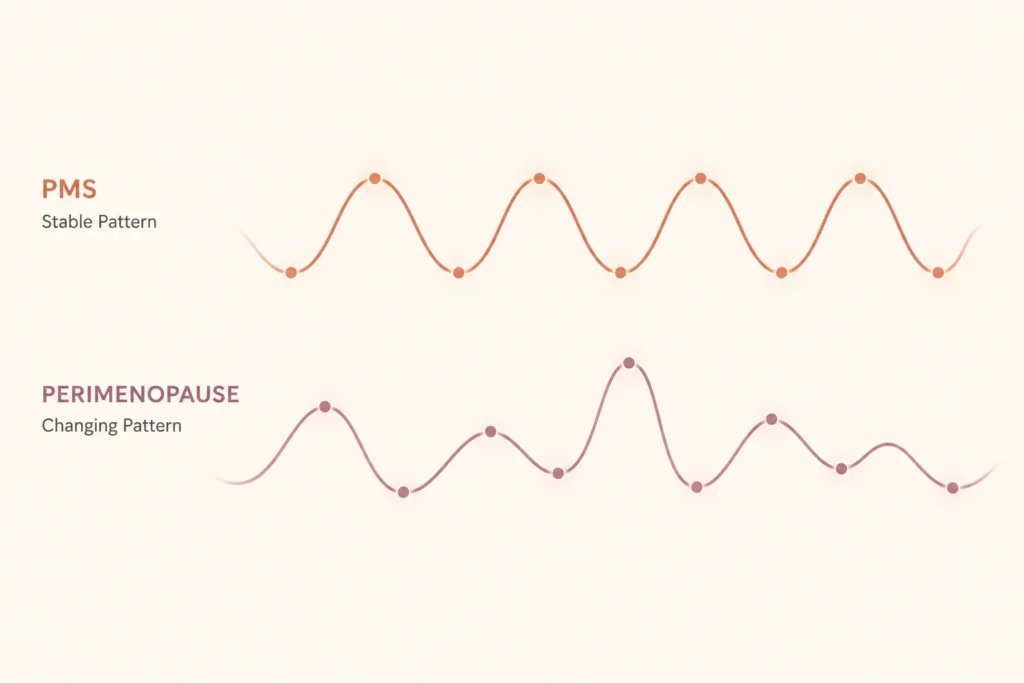
The reason perimenopause and PMS are so easily mistaken for each other is that they share a mechanism. Both are driven by your sensitivity to the natural rise and fall of estrogen and progesterone across your cycle. PMS is your brain and body reacting to the normal monthly hormonal shift. Perimenopause symptoms come from the same hormonal machinery, except now the rise and fall is becoming erratic and exaggerated rather than smooth and predictable.
So the symptoms feel like cousins, because they are. The difference is that PMS is a stable response to a stable cycle, and perimenopause is an escalating response to a destabilising one.
The PMDD piece worth knowing
If you have a history of PMDD (premenstrual dysphoric disorder, the severe form of premenstrual mood disruption) pay particular attention. Women with PMDD are more sensitive to hormonal fluctuation to begin with, and that sensitivity often means perimenopause hits harder and earlier. If your previously-managed PMDD has suddenly intensified, or stopped responding to what used to help, perimenopause may now be part of the picture. The mood symptoms in particular, the rage, the anxiety, can escalate sharply, which is its own under-discussed corner of this transition covered in our piece on perimenopause rage.
Why Getting It Wrong Costs You Years

This is the part the ‘it’s just PMS’ conversation skips, and it’s why this distinction matters beyond getting the label right.
When perimenopause is filed under ‘worsening PMS,’ the response is usually one of two things: you’re told to manage it the way you’ve always managed PMS (which no longer works, because the underlying situation has changed) or you’re put on the combined pill to smooth out the cycle, without ever being told that the hormonal transition driving your symptoms even exists, or that other options exist for it. Either way, the actual cause goes unaddressed.
And the clock keeps running. Nearly 40% of women seeking help for what turns out to be perimenopause are misdiagnosed, and more than half are treated for something else: anxiety, depression, or simply ‘PMS, take some evening primrose oil.’ The result is women spending years, sometimes the entire early transition, being managed for the wrong thing, while the symptoms quietly escalate. Getting the distinction right early is what turns years of being dismissed into a conversation that actually goes somewhere.
How to Tell Which One You’re Dealing With
You don’t need a lab to start answering this. The distinction lives in the pattern over time, so the most useful thing you can do is look honestly at four questions:
- Has it got worse than it used to be? Not just a bad month, but a genuine escalation over the last one to two years. Stable = more likely PMS. Escalating = look at perimenopause.
- Are there new symptoms? Brain fog, 3am waking, heart palpitations, anxiety that doesn’t attach to anything: symptoms you didn’t used to get with your PMS. New symptoms point toward perimenopause.
- Is your actual cycle changing? Length, flow, predictability. PMS doesn’t change your cycle. Perimenopause does. This is one of the clearest tells.
- Are you in your late 30s or older? PMS can be lifelong, but if a long-stable pattern starts shifting in your late 30s or 40s, the timing fits perimenopause.
Two or more ‘yes’ answers, especially a changing cycle alongside new or escalating symptoms, and you’re looking at something more than PMS. That’s not a diagnosis, but it’s enough to stop accepting ‘just PMS’ as the final word.
What to Do Now

The single most useful step is to track the pattern, because the pattern is the evidence. For the next two cycles, note your symptoms, their severity, and where you are in your cycle each day, paying special attention to whether anything is landing outside the usual pre-period window or whether your cycle length is shifting.
Two cycles of that gives you something concrete: not ‘I think my PMS is worse,’ but ‘here is a documented pattern of escalating symptoms, new cognitive changes, and a cycle that’s shortened by four days.’ That’s the difference between being told to take magnesium and being taken seriously. And if you’re walking into an appointment with a doctor who’s already called it PMS once, how to talk to your doctor without being dismissed gives you the language that gets the hormonal picture onto the table.
| Track the pattern: free 30-Day Perimenopause Symptom Tracker Maps your symptoms against your cycle so you can see whether this is the stable pattern of PMS or the changing pattern of perimenopause. Print-ready for your appointment. Five minutes a day, no account, no spam. Download free |
Common Questions
Can you have PMS and perimenopause at the same time?
Yes, and it’s common. Perimenopause doesn’t replace PMS; it often arrives on top of it. If you’ve had PMS for years, the early transition frequently shows up as that familiar pattern getting louder and less predictable. The two aren’t mutually exclusive, which is exactly why ‘is it PMS or perimenopause’ is rarely a clean either/or in your late 30s.
Does PMS get worse during perimenopause?
Very often, yes. ‘My PMS suddenly got so much worse’ is one of the most common ways women describe the start of perimenopause. The same luteal-phase response is still there, but the erratic, exaggerated hormonal swings of the transition amplify it: longer bad spells, sharper moods, and symptoms that don’t lift as cleanly when your period starts.
At what age does PMS ‘turn into’ perimenopause?
There’s no fixed age, and that’s the point: watch the pattern, not the birthday. PMS itself doesn’t convert into perimenopause; rather, perimenopause begins layering on top of it, typically from the late 30s onward. If a pattern that’s been stable for two decades starts changing in your late 30s or 40s, the timing fits perimenopause regardless of the exact year.
You’re Not Imagining That It’s Different Now
You’ve lived in this body for decades. You know what your normal PMS feels like, and you know that what’s been happening lately isn’t quite it. That instinct is worth trusting.
Perimenopause vs PMS isn’t a trick question with a clever answer. It’s a matter of whether the pattern is holding steady or changing, and if yours is changing, you deserve to have that looked at as what it might actually be, not waved off as the same thing you’ve always had. You haven’t suddenly become someone who can’t cope with a bit of PMS. Something is genuinely different. And now you know how to tell what.
Related Reading on This Site
- Early signs of perimenopause in your late 30s and early 40s the full symptom picture, including which ones show up first.
- Why am I getting perimenopause symptoms at 38? if the age question is the part that keeps nagging at you.
- Perimenopause vs anxiety: why 40% of women in their 30s are misdiagnosed if the anxiety piece is the biggest thing you’re dealing with.
- How to talk to your doctor about perimenopause without being dismissed scripts for the appointment that hasn’t gone well yet.
- Should you start HRT in perimenopause? A decision framework once you’re ready to think about treatment options.
- At-home hormone tests for perimenopause 4 options compared if you want a baseline before your next appointment.
This article is for informational purposes only and does not constitute medical advice. Please consult a qualified healthcare provider if you are experiencing symptoms that concern you.