


This article contains affiliate links. If you purchase through our links, we may earn a small commission at no extra cost to you. This does not affect our editorial recommendations.
If your doctor has looked at your results and said everything’s normal, while you’re lying awake at 3am feeling like a completely different person, you already know something isn’t adding up.
Here’s what I want you to know before you spend money on a test: at-home perimenopause tests are genuinely more complicated than fertility testing or pregnancy testing, for one specific reason. A single hormone reading doesn’t confirm perimenopause, not even a high FSH. What testing can do is show you whether anything is actually changing, build a picture over time, and give you something concrete to bring to your next appointment, so you don’t walk in with ‘I just feel off’ and walk out with a prescription for antidepressants. If you’re not yet sure this is perimenopause at all, start with our guide to the early signs of perimenopause in your 30s.
This guide compares the four tests worth knowing about (Mira, Inito, Everlywell, and Modern Fertility) including which is best for your specific situation, what each one actually tells you, and which one most women wish they’d skipped.
| Quick summary: at a glance Best for trend tracking over time: Mira (monitor + strips; measures LH, E3G, PdG, FSH) Best for a comprehensive hormone picture at home: Inito (measures FSH, LH, E3G, PdG as standard) Best for a low-cost one-off: Everlywell Perimenopause Test (understand the limitations first) Best if fertility is also part of your question: Modern Fertility Hormone Test Want a clinician to run your labs and interpret them? See the telehealth section below. |
Why At-Home Perimenopause Tests Are So Complicated
Before you spend money on a test, it’s worth understanding the specific problem with testing for perimenopause, because it’s different from testing for, say, a thyroid condition.
The dirty secret: hormone levels alone don’t diagnose perimenopause
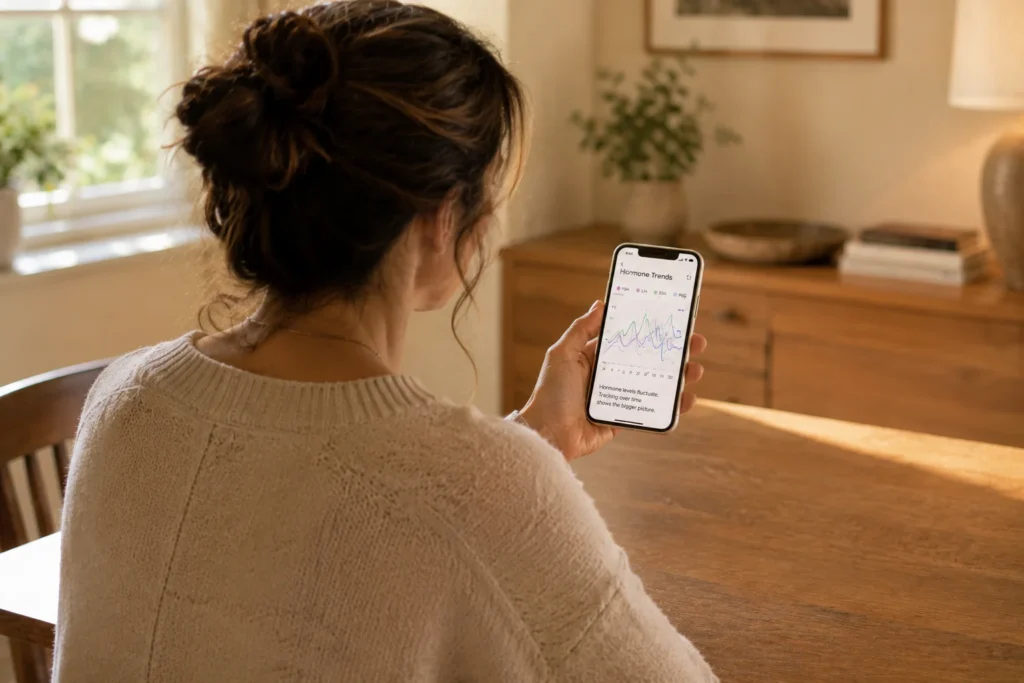
Perimenopause is defined by a pattern of hormonal fluctuation over time, not by a single reading on a single day. Estrogen and progesterone don’t decline in a straight line during the transition; they swing, sometimes dramatically. FSH (follicle-stimulating hormone), the most commonly cited ‘perimenopause test’, is produced by the pituitary to stimulate the ovaries, and rises when the ovaries aren’t responding as they once did. A high FSH can suggest perimenopause. But FSH also varies across the menstrual cycle. A single high reading taken on the wrong day can look alarming. A single normal reading taken on the wrong day can look reassuring. Neither is the whole picture.
This is why the standard medical guidance is: a single FSH test doesn’t diagnose perimenopause. Two elevated readings, taken at least a month apart, is the more meaningful signal. And even then, clinical diagnosis relies on symptoms and history alongside the bloodwork.
None of this makes testing a waste of time. It means you need to understand what you’re testing for, and what a result actually tells you.
So why test at all? What useful information you actually get
If your symptoms are the reason you’re here, the most useful thing testing can do is connect what you’re feeling to a hormonal pattern. Specifically, testing at home can do three genuinely useful things:
Establish a baseline, so you have a reference point for future comparisons.
Identify patterns over multiple cycles, when you use a monitor that tracks trends rather than a one-off test.
Give you documented evidence to bring to a GP appointment, a telehealth consultation, or a specialist, so the conversation starts from ‘here’s my data’ rather than ‘I just feel off.’
The women who get the most value from at-home hormone testing are those who treat it as a data-gathering tool rather than a diagnostic tool. The result isn’t the answer. The result is the beginning of a better conversation.
The 4 Ways to Test for Perimenopause at Home
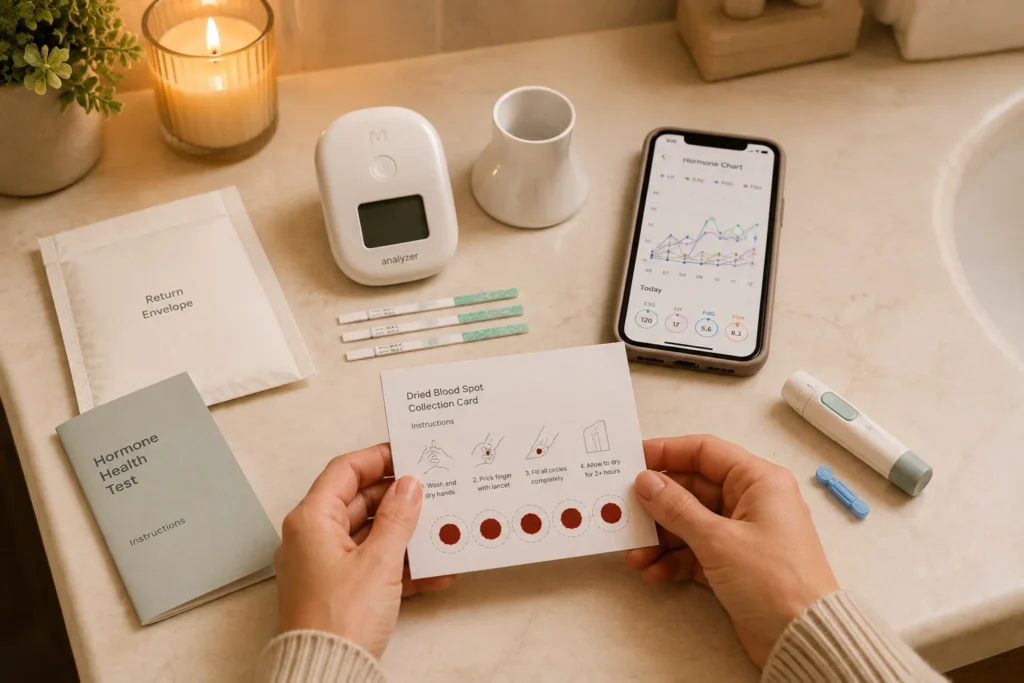
If you’re looking for a perimenopause blood test at home, the Everlywell and Modern Fertility options use dried blood spot collection: a finger-prick method processed by a certified lab. Mira and Inito use urine and a reusable device. Here’s how they compare:
Measures: LH, E3G, PdG, and FSH (depending on the strips used)
Method: Urine testing with a connected device and mobile app
Cost: Approximately $199 for the device plus around $60 per month for test strips
Best for: Tracking hormone trends and building cycle awareness over time
Key limitation: Requires consistent daily testing and comes with a learning curve for the app
Measures: FSH, LH, E3G, and PdG as standard
Method: Urine testing with a connected device and mobile app
Cost: Approximately $129–149 for the device plus the cost of test strips, with no subscription required
Best for: Getting a more complete hormone picture, with FSH included as a core feature
Key limitation: The app is less mature than some competitors and guidance for irregular cycles can be inconsistent
Measures: FSH, LH, and estradiol
Method: Dried blood spot sample mailed to a laboratory
Cost: Approximately $149 as a one-time purchase
Best for: A simple hormone snapshot without needing a monitoring device
Key limitation: A single test result has limited value when trying to understand fluctuating perimenopause hormones
Measures: AMH, FSH, LH, prolactin, TSH, and estradiol
Method: Dried blood spot sample mailed to a laboratory
Cost: Approximately $199 as a one time purchase
Best for: Women who want fertility and hormone information together
Key limitation: Primarily designed for fertility assessment and is now offered through Ro
Mira: The One That Tracks Trends, Not Just Snapshots
What Mira actually measures
Mira is a wand-style urine analyzer paired with an app. Depending on which strips you use, it measures some combination of LH (luteinizing hormone), E3G (a urine metabolite of estradiol), PdG (a progesterone metabolite), and FSH. The app plots your readings across your cycle and over time, the key feature for perimenopause, because you’re looking for the pattern, not the number.
FSH strips were added relatively recently and are directly relevant for perimenopause monitoring. An elevated FSH on a Mira reading, especially if it’s consistent across multiple cycles, is a more meaningful signal than a single lab result, because you’re seeing the fluctuation for yourself. An LH surge that arrives earlier in the cycle than it used to is one of the earliest perimenopause signals a monitor can detect, and Mira captures this. Mira gives you actual numbers rather than a yes/no result, which makes it significantly more useful if you want to bring data to a clinician.
Who Mira is genuinely good for
Mira is built for women who want to understand what’s happening across their cycle over time, not just on one day. If you’re the kind of person who wants data rather than a verdict, and you’re willing to test consistently to get it, this is the right tool. Specifically:
Women still having cycles (regular or irregular) who want to understand what’s happening across them.
Women already charting or tracking who want to add hormone data to their picture.
Women who want longitudinal data (readings over 3–6 months) to present to a telehealth provider or specialist.
Women willing to test consistently (ideally daily or near-daily during certain cycle phases) to get meaningful trend data.
Honest weaknesses
Upfront cost is significant. The device alone is ~$199, and strip packs add up over time.
It requires consistent use to produce useful data. A box of strips used sporadically gives you noise, not signal.
If your cycles have already become very irregular or absent, the cycle-based tracking model is less meaningful.
The app learning curve is real; it takes several weeks before there’s enough data for pattern insight.
Inito: The Closest Thing to a Lab in Your Bathroom
What Inito measures and how
Inito is a smartphone attachment that reads urine test strips and measures four hormones simultaneously: FSH, LH, E3G, and PdG. It was originally developed for fertility tracking (identifying the fertile window) but its FSH and LH measurement makes it directly applicable for perimenopause monitoring.
The key differentiator from Mira is that Inito measures FSH natively as a core feature rather than as an add-on strip. For perimenopause monitoring specifically, FSH is the most-watched variable, which makes Inito’s architecture well-suited to this use case even if fertility tracking isn’t your goal. Inito doesn’t require a subscription; strips are purchased separately with no ongoing fee beyond the device. Like Mira, it gives actual numbers and stores them in an app so you can see trends across cycles.
Who Inito is best suited for
Women who want the most comprehensive at-home hormone picture, measuring all four key hormones across their cycle.
Women who may also have fertility questions alongside perimenopause questions.
Women who want a device-based monitor but find Mira’s ongoing strip costs prohibitive.
Honest weaknesses
Like Mira, Inito requires consistent use to generate meaningful data; it’s not a one-off answer.
The app interface and interpretation guides are still maturing; some users find the data presentation less intuitive than Mira’s.
If you have very irregular cycles, the fertility-tracking framing of some guidance can feel irrelevant.
Customer-support response times have been flagged in some reviews as slower than expected.
Everlywell Perimenopause Test: Convenient, But Know the Limitations
What the Everlywell test actually gives you
The Everlywell Perimenopause Test is a mail-in dried blood spot test that measures FSH, LH, and estradiol. You prick your finger, collect a small blood sample on a card, mail it to a CLIA-certified lab, and receive results via the Everlywell app within a few days: your levels, a reference range, and a brief interpretation. For a lot of women this is appealing because it’s simple and doesn’t require a device or ongoing strips. You buy a kit, do the test once, get a number.
Who it works for (and who it doesn’t)
It works for women who want a one-off baseline and accept that a single reading is a snapshot, not a diagnosis. If you’ve never had your hormones tested before and want a reference point, Everlywell is a reasonable starting point; it measures FSH, the most relevant single marker for perimenopause, alongside LH and estradiol.
On accuracy: dried blood spot collection is a validated method used by CLIA-certified labs and is considered reliable for FSH measurement. It isn’t identical to a venous draw (there can be slightly more variability) but the difference is unlikely to be clinically meaningful for establishing a baseline.
It is less useful for women who want to track trends, understand cycle patterns, or produce data a clinician is likely to act on. A single FSH result, particularly in the ‘normal’ range, is unlikely to move the needle in a GP appointment. Normal can still mean perimenopause is progressing. Normal can still mean your symptoms are real.
Why this is the one most women wish they’d skipped
The honest limitation of the Everlywell test is the honest limitation of single-point hormone testing for perimenopause: FSH fluctuates. A result in the normal range doesn’t rule out perimenopause; a result in the elevated range doesn’t confirm it. Women who buy this test hoping for a definitive answer tend to come away with a result that says ‘normal’ or ‘elevated’ and no framework for what that means. That’s not a criticism of Everlywell specifically; it’s a structural limitation of one-off testing for this question. If you understand this going in, the test is useful. If you’re hoping for a yes or no, you’re likely to be frustrated.
Modern Fertility Hormone Test: Built for a Different Question
What it measures and the fertility vs. perimenopause distinction
Modern Fertility’s hormone test measures a broader panel than Everlywell: depending on the test, it can include AMH (anti-Müllerian hormone), FSH, LH, prolactin, TSH, and estradiol. It’s a dried blood spot mail-in test with lab results delivered via app. (Worth knowing: Modern Fertility is now part of Ro, and the test is offered through Ro’s platform; confirm current availability before you order.)
AMH is where Modern Fertility differs most. AMH is a direct marker of ovarian reserve: how many eggs remain. Critically, declining AMH is also one of the earliest measurable signals of the approach of perimenopause, often dropping years before FSH begins to rise or symptoms appear. For a woman in her late 30s who wants to understand both her hormonal picture and where she is on the perimenopause timeline, AMH alongside FSH gives a richer picture than FSH alone.
When Modern Fertility is the right call
Modern Fertility is the right test if your question is actually two questions: ‘Is this perimenopause?’ and ‘What does this mean for my fertility?’ These are different questions, and for women in their late 30s and early 40s they’re often inseparable. If you’re still considering pregnancy or want to understand your ovarian reserve alongside your hormonal picture, this gives you the most complete one-off answer available at home.
If fertility is not part of your question at all, if you’re trying to understand your hormones purely to explain your symptoms and inform treatment decisions, the perimenopause-specific options (Mira or Inito for trend tracking, Everlywell for a one-off baseline) are more directly suited to your situation.
What to Do With Your Results (This Is What Most Articles Skip)
You’ve done the test. You have a number. Now what? This is the part of the at-home testing experience that most buyers feel let down by, not because the test failed to work, but because the result arrives with an interpretation framework that isn’t quite designed for the question you were actually asking.
What ‘abnormal’ actually means on a hormone test at 38–44
Reference ranges on at-home hormone tests are typically calibrated against the general population, which means they include post-menopausal women with very high FSH and reproductive-age women with very low FSH in the same ‘normal’ band. An FSH result in the ‘normal’ range for a 38-year-old isn’t evidence that she’s not in perimenopause. It’s evidence that her FSH on the day she tested was within a wide population range.
The more meaningful signal is trend. If you’re using Mira or Inito over multiple cycles, you’re looking for FSH trending upward, LH spiking earlier in the cycle than expected, and E3G that’s increasingly erratic. These pattern changes, even within ‘normal’ reference ranges, are consistent with early perimenopause. A ‘high’ FSH reading is clinically notable. A ‘normal’ FSH reading in the context of escalating symptoms is also notable: it tells you your symptoms aren’t being explained by a single hormone marker on a single day, which is itself a useful clinical finding.
What to bring to your doctor’s appointment
If you’ve done a one-off test: bring the lab printout, your symptom timeline (written over 4–6 weeks, mapped to your cycle), and a specific question. Not ‘do I have perimenopause’, because the answer is almost always ‘we’d need to monitor over time.’ Instead: ‘My FSH came back at [X]. Given my symptoms over the past six weeks ([name them specifically]) I’d like to discuss whether this warrants monitoring and what the next appropriate step is.’
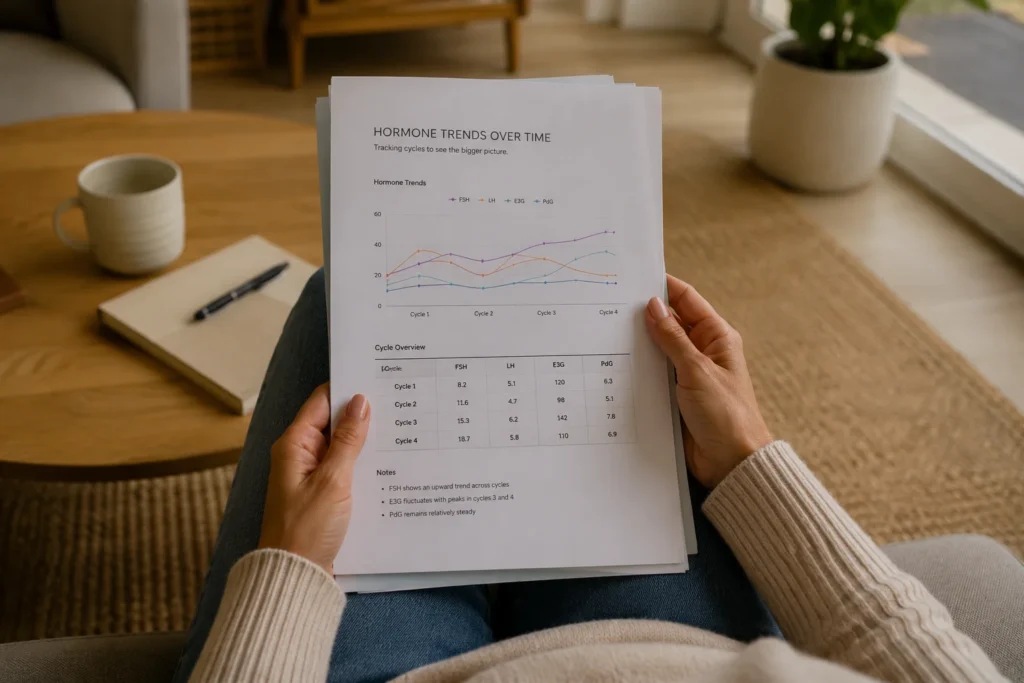
If you’ve done trend tracking with Mira or Inito: export your data from the app before your appointment. Both let you generate a PDF graph of FSH and other hormones across multiple cycles; that’s the document to bring. A trend graph showing FSH rising across three cycles shifts a clinical conversation in a way a verbal description of symptoms cannot.
When a test result isn’t enough: the case for telehealth
If you’ve got your Mira or Inito data in front of you and you’re looking at three months of rising FSH alongside symptoms that aren’t going away, that’s enough to walk into a telehealth consultation and be taken seriously. You don’t need to wait another six months for a GP appointment to confirm what the data is already showing.
Midi, Alloy, and Winona are the three largest perimenopause telehealth providers in the US. All three can order and interpret lab work as part of an initial consultation. The advantage over your GP is that they specialize in this. They’re not going to look at an FSH of 14 in a 41-year-old with your symptom picture and say ‘that’s normal.’ They’ll look at it in context. If this route is relevant, our Midi vs Alloy vs Winona comparison covers what each service costs, what they can prescribe, and how to choose. And if you’re weighing whether to start treatment at all, our HRT decision framework walks through it.
Frequently Asked Questions
Can you test for perimenopause at home accurately?
You can measure relevant hormone levels at home accurately; the testing technology is reliable. What you cannot do is confirm a perimenopause diagnosis from a single home test. Accurate testing and a definitive diagnosis are two different things. At-home tests give you useful data; they don’t replace clinical assessment.
What is the most accurate at-home perimenopause test?
For a single-point result, the Everlywell Perimenopause Test uses CLIA-certified lab processing with dried blood spot collection, a validated method. For ongoing accuracy and clinical utility, Mira and Inito are more useful over time because they give you trend data rather than a snapshot, and trend data is what’s actually diagnostically meaningful for perimenopause.
What hormone levels indicate perimenopause?
There is no single threshold. FSH above 10 mIU/mL in a woman still having periods can be an early indicator; FSH consistently above 25–30 mIU/mL is associated with the approach of menopause. But FSH varies by cycle phase and day; a reading needs to be interpreted in context, not against a fixed number. Low AMH (below 1.0 ng/mL) alongside elevated FSH in a woman under 45 is a more meaningful pattern than either marker alone.
Is Mira or Inito better for perimenopause?
Both are strong. Mira has been on the market longer, has a more established user base, and its app is generally considered more polished. Inito measures all four key hormones including FSH as a core feature rather than an add-on, and can be a better fit for women who want the most complete hormone picture from the start. Most women don’t need both: Mira if you want the more refined app experience, Inito if FSH measurement as standard is the priority.
Do these tests work if I’m still having periods?
Yes. In fact, having cycles is an advantage for Mira and Inito, because the cycle structure gives the apps a framework for interpreting your readings. Testing on specific cycle days produces more interpretable data than testing randomly. The Everlywell and Modern Fertility mail-in tests also work during active cycles; they’re typically recommended for day 3 of your cycle, when FSH is most consistently comparable.
What if my results come back normal but I still feel terrible?
Then trust what you know. A normal result does not mean your symptoms aren’t real or that perimenopause isn’t progressing. FSH fluctuates, and a single normal reading on a single day isn’t the whole picture. The next step is trend tracking over time with Mira or Inito, so you’re not relying on one data point, or a telehealth consultation where a clinician who specializes in this assesses your symptoms alongside your labs, not instead of them.
The Bottom Line: Which Test Is Right for You?
The most common mistake women make with at-home hormone testing is expecting a definitive answer from a tool designed to provide a data point. These tests are useful. They are not the answer; they’re the evidence you need to get to the answer.
Used correctly (as a baseline, as a trend tracker, as something to walk into a room with) they can shift the conversation from ‘I feel off and nobody is listening’ to ‘here is three months of FSH data and I’d like to discuss what it means.’ That shift is not small.
If you’ve been told your labs are normal and you still don’t feel like yourself: keep going. The data will catch up with what you already know.
| Your situation | Best choice |
| You want to track hormone trends over multiple cycles and build a picture over time | Mira: strongest trend data, established app, FSH strips available |
| You want the most comprehensive at-home hormone picture from a single device | Inito: measures all four key hormones including FSH as standard, no subscription |
| You want a one-off result and understand a single reading is a snapshot, not a diagnosis | Everlywell Perimenopause Test: convenient, CLIA-certified lab, lowest commitment |
| Your question includes fertility as well as perimenopause | Modern Fertility (via Ro): AMH alongside FSH gives ovarian reserve and the perimenopause picture together |
| You want a clinician to run your labs and interpret them with treatment options | Telehealth (Midi / Alloy / Winona): see our full comparison, or the HRT decision framework |
| Ready to choose? Here’s where to go based on your situation: Track trends over time → Mira Most complete hormone picture at home → Inito A one-off test, limitations understood → Everlywell Fertility is also part of the question → Modern Fertility (via Ro)A clinician to run and interpret your labs → compare Midi, Alloy & Winona |
This article is for informational purposes only and does not constitute medical advice. Please consult a qualified healthcare provider regarding your specific health situation.