


This article contains affiliate links. If you purchase through our links, we may earn a small commission at no extra cost to you. This does not affect our editorial recommendations.
You snapped. At your partner over something small. At your kids over something you would have brushed off two years ago. Maybe at a colleague, or at yourself, standing in the kitchen wondering why you’re this angry about nothing.
And then came the guilt. Because that’s not who you are. You’re the one who manages everything: the job, the logistics, the mental load that never quite ends. You don’t lose it. Except lately, you do. And you can’t explain it.
If you’re in your late 30s or early 40s and your anger has started to feel like it belongs to someone else, disproportionate, cyclical, and almost separate from your actual thoughts, there is a name for what’s happening. It’s not burnout, even though burnout is probably also real. It’s not a personality shift. It’s not a sign that your relationship is broken or that you’ve become someone you don’t recognize.
It is perimenopause rage. And the mechanism behind it is documented, hormonal, and, critically, treatable. It is not your fault. It is your estrogen.
This article covers what’s actually happening in your brain and body, how to recognize the pattern, and the four things that can genuinely help, in order from least to most intervention. No generic advice. No ‘manage your stress.’ Real options, real mechanisms, real talk.
| Is this you? If you’re experiencing anger that feels disproportionate to what triggered it, clusters in the 10–14 days before your period, and comes with a guilt spiral you can’t quite explain, that is a hormonal pattern. Keep reading. This article explains exactly what’s driving it and what you can actually do about it. |
What Is Perimenopause Rage? (And Is It Different From Normal Anger?)
Perimenopause rage is not just being in a bad mood. It is a specific, hormonally driven pattern of anger that is disproportionate, cyclical, and hard to explain away with circumstances.
The key word is disproportionate. The situation doesn’t match the reaction. You know, even in the middle of it, that the level of anger isn’t quite right for what triggered it. And that awareness makes it worse, because you’re watching yourself respond in a way you can’t seem to control.
The second key word is cyclical. This is the tell. Perimenopause rage tends to cluster in the second half of your menstrual cycle: the luteal phase, roughly the 10–14 days before your period. If you track your worst days and they keep landing in that window, that is a hormonal pattern, not a stress pattern.
You may also see this called perimenopausal rage, perimenopausal irritability, or hormone-imbalance anger. The terminology varies depending on where you’re searching, but the experience is the same: mood swings and anger episodes that feel out of character and out of proportion.
What it is often mistaken for:
- General burnout or work stress
- Depression or a depressive episode
- PMDD (premenstrual dysphoric disorder), which has real overlap, but a different primary driver
- Relationship problems, parenting difficulties, career pressure
- ‘Just being stressed’: the default answer that explains nothing and helps no one
Here is one thing worth naming directly: nearly 40% of women seeking care for perimenopause symptoms are misdiagnosed. More than half are treated for anxiety or depression instead. The rage is real, the hormonal mechanism is documented, and the fact that your doctor hasn’t flagged it doesn’t mean it isn’t happening.
It also doesn’t mean hot flashes need to be present. For many women in their late 30s and early 40s, mood symptoms (rage, anxiety, irritability, low mood) arrive before physical symptoms. Before the hot flashes. Before the night sweats. Psychological symptoms of perimenopause peak between ages 41 and 45, which is exactly the window where doctors are most likely to say you’re too young for this.
What’s Actually Happening in Your Brain (The Biology in Plain English)
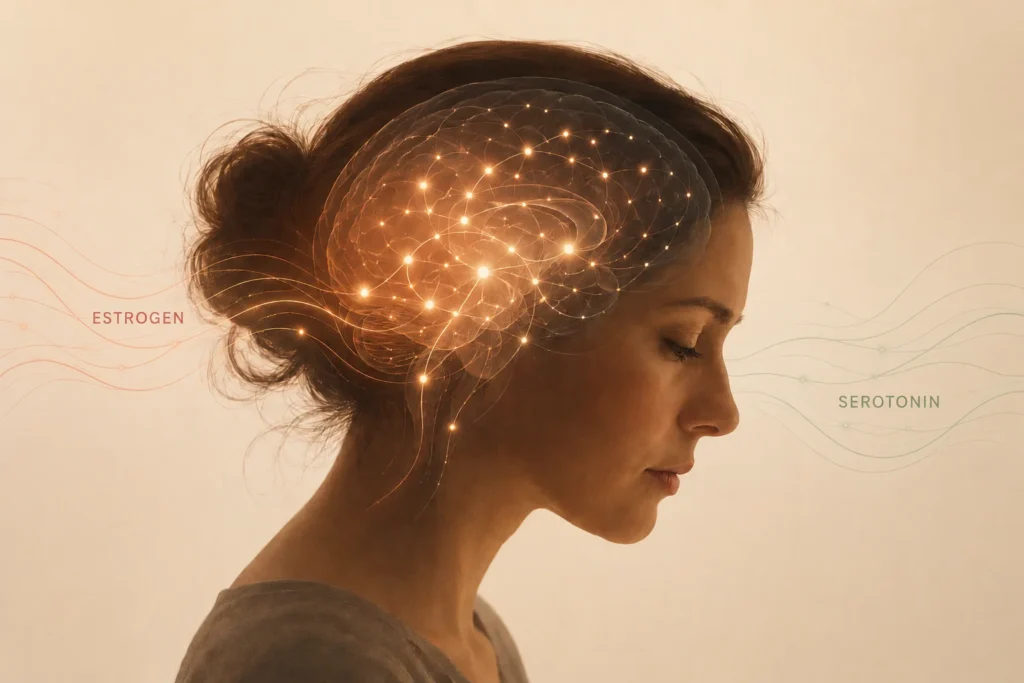
Estrogen is not just a reproductive hormone. It is a neuroactive hormone that directly regulates serotonin, dopamine, and norepinephrine: the three neurotransmitters most responsible for mood stability, emotional regulation, and the ability to respond to stress without going to pieces. The relationship between estrogen and mood is direct, not metaphorical.
When estrogen levels are stable, these systems run relatively smoothly. When estrogen begins to fluctuate erratically, which is what happens in perimenopause as ovarian function becomes less predictable, serotonin becomes unstable. An unstable serotonin system can lead to an unstable emotional state.
Progesterone has its own role in this picture. In a regular cycle, progesterone rises in the luteal phase and has a natural calming effect on the nervous system: it acts on GABA receptors, the same system that anti-anxiety medications target. As perimenopause progresses, progesterone often starts declining first. Which means the natural calming buffer gets thinner before everything else does.
| The short version: estrogen fluctuates → serotonin becomes unstable → emotional regulation becomes harder. Progesterone declines → the natural calming effect reduces → the nervous system runs hotter. Add in chronically elevated cortisol, almost inevitable if you’re a high-functioning woman managing more than one person’s life, and the system is primed to fire hard at small triggers. |
The cortisol amplification effect
This is not metaphorical. The estrogen-serotonin link is well established in the research literature. This is a biological mechanism, not a character flaw. It also explains why the rage can feel so separate from you, because in a real sense, it is. It is your hormones affecting your neurotransmitter systems, not your personality deteriorating.
High cortisol, the kind that comes from years of managing everything and rarely fully switching off, sensitizes the stress response system. When estrogen drops and serotonin becomes unstable, a sensitized stress response fires faster and harder. The women who are hit hardest by perimenopause rage are often the most capable, most organized, most high-functioning ones. Because they’ve been running on cortisol for years. That is not a coincidence. That is the mechanism.
The Symptom Pattern: How to Know If This Is What You’re Experiencing
Not every anger episode is perimenopause rage. But there is a pattern that tends to distinguish it from general stress responses. Whether you’re calling it perimenopause irritability, hormone-imbalance anger, or simply ‘I don’t recognize myself anymore’, the pattern below is the tell.
| What you’re experiencing | What it probably is |
|---|---|
| Anger that feels out of proportion to what triggered it | Serotonin instability: the emotional thermostat is running high |
| Anger that clusters in the 10–14 days before your period | Luteal-phase hormonal drop: this is the pattern signature |
| A specific feeling of shame or guilt after the episode | You have emotional insight: it feels like it came from outside you |
| A sense of watching yourself react and not being able to stop it | The prefrontal cortex is being overridden by the limbic system under hormonal stress |
| Snapping at people you love and immediately regretting it | Classic presentation: the target is usually the people you feel safest with |
| Anxiety and anger arriving together | Estrogen–serotonin disruption affects fear response and emotional regulation simultaneously |
| Feeling fine, even good, in the first half of your cycle | Follicular phase: estrogen rising, serotonin more stable. Confirms the hormonal pattern |
| The anger feeling unfamiliar, like it doesn’t belong to you | Accurate read. It is hormonally driven, not character-driven |
A simple way to track the pattern
You don’t need an app or a specialist to start gathering evidence. For the next two cycles, note three things every day: your mood on a simple 1–10 scale, where you are in your cycle (estimate if periods are irregular), and any specific anger or irritability episodes.
If a pattern emerges — if the worst days cluster predictably in the back half of your cycle — that is the information you need. Bring it to a medical appointment. ‘I’ve been tracking this for 60 days and I can show you the pattern’ is a very different conversation from ‘I’ve been feeling really angry lately.’
| Quick self-assessment: Do your worst mood days cluster in the 10–14 days before your period? Does the anger feel disproportionate to the trigger? Do you have the experience of watching yourself react and not recognizing it as yourself? Are you in your late 30s or early 40s? If you answered yes to three or more, the rest of this article is written for you. |
The 4 Things That Actually Help (In Order of Least to Most Intervention)

These are not generic wellness suggestions. Each one has a specific mechanism that addresses the underlying hormonal and neurological drivers of perimenopause rage and mood swings. They are ordered from lowest to highest intervention so you can start where feels right for you.
1. Magnesium glycinate: the underrated first step. Magnesium is involved in over 300 enzymatic processes in the body, including several that directly affect mood regulation and the stress response. In the context of perimenopause rage, the most relevant mechanism is magnesium’s role in regulating the HPA axis: the hormonal system that controls cortisol production.
When magnesium is depleted (extremely common in women under chronic stress), cortisol rises, the nervous system runs hotter, and emotional reactivity increases. Supplementing with magnesium helps regulate that response.
Why glycinate specifically? There are several forms of magnesium. Glycinate is chelated with glycine, an amino acid with its own calming properties, and it’s well-absorbed without the digestive side effects that magnesium oxide or citrate can produce. For mood and sleep, glycinate is the form most consistently recommended by practitioners working with perimenopausal women.
What to take: 300–400mg of magnesium glycinate in the evening, ideally 1–2 hours before bed. The sleep benefits tend to show up first; the mood effects typically take 2–4 weeks of consistent use to become noticeable.
Realistic expectations: magnesium glycinate will not eliminate perimenopause rage on its own. It lowers the baseline, reduces the cortisol amplification effect, and often improves sleep enough that the rage pattern becomes less severe. For mild to moderate symptoms, it can make a meaningful difference. For moderate to severe symptoms, it is the foundation layer under whatever else you add.
| What to look for: a pure magnesium glycinate supplement from a reputable brand. Pure Encapsulations and Thorne both manufacture to pharmaceutical-grade standards with third-party testing. Avoid anything labeled simply ‘magnesium complex,’ which often contains cheaper oxide forms that don’t absorb as well. For the full breakdown of brands, forms, and dosing, see our guide to the best magnesium for perimenopause sleep. |
2. Bonafide Relizen: non-hormonal, clinically studied. If you want a non-hormonal option with actual clinical evidence behind it, not just supplement marketing, Relizen is one of the few with peer-reviewed, placebo-controlled studies supporting it.
Relizen is made from a purified pollen extract called Serelys. The clinical research on it was conducted largely in Sweden and has been published in peer-reviewed journals. The studies show statistically significant improvements in both vasomotor symptoms (hot flashes, night sweats) and mood symptoms, including irritability, compared to placebo.
The mechanism is not fully understood but is believed to involve the serotonergic and dopaminergic systems rather than estrogen receptors, which is why it’s considered safe for women who cannot take hormonal treatments, including those with a history of hormone-sensitive cancers.
Who it’s best for: women who want a clinically studied, non-hormonal option; women who cannot or do not want to use HRT; women experiencing moderate mood symptoms alongside other perimenopause symptoms who want one product that addresses multiple issues.
Honest caveats: Relizen takes 8–12 weeks to show its full effect. It is not a rapid intervention. It runs roughly $38–58 per month depending on whether you subscribe or buy single boxes. And like all supplements, individual response varies: some women see significant improvement, others modest, and a small percentage don’t notice much difference.
| Before you buy: Bonafide Relizen offers a subscription that reduces the per-month cost. If you’re going to give it a proper trial, which means at least 90 days, the subscription makes more economic sense than buying single bottles. |
3. The lifestyle protocol: unsexy but non-negotiable. Let’s be honest about what this section is and isn’t. It isn’t a cure. It won’t resolve perimenopause rage on its own if your hormones are fluctuating significantly. But it is the layer that either amplifies or undermines everything else you do. If you’re supplementing and not sleeping, the supplements will underperform. If you’re addressing hormones but your cortisol is through the roof from chronic undereating and overworking, the hormonal support has a harder job.
The three interventions with the clearest evidence for mood regulation in perimenopause:
Sleep, even partial improvement matters. The estrogen-serotonin disruption makes sleep harder at exactly the same time as sleep deprivation makes estrogen-related mood symptoms worse. It’s a compounding loop. You don’t have to fix it perfectly; even moving from 5.5 to 6.5 hours of consolidated sleep shifts the nervous system’s baseline. Magnesium glycinate supports this. Reducing evening alcohol helps significantly (it fragments sleep architecture even in small amounts). A small protein snack if you wake in the early hours addresses the 3am cortisol spike many perimenopausal women experience.
Protein intake, more than you probably think. Estrogen has an anabolic effect on muscle. As it fluctuates, muscle mass becomes harder to maintain and the liver’s ability to manage blood sugar shifts. Higher protein intake — aiming for 1.2–1.6g per kg of body weight — supports both muscle maintenance and blood sugar stability. Blood sugar spikes and crashes directly amplify cortisol and emotional reactivity. This is a mood-regulation tool, not a weight-loss recommendation.
Blood sugar stability in the luteal phase. Many women notice their rage pattern is worse when they’ve been eating more refined carbohydrates or skipping meals, because blood sugar instability amplifies the cortisol-estrogen loop. In the 10 days before your period, paying extra attention to balanced meals (protein and fat at every meal, less refined sugar and alcohol in that window) can noticeably reduce the severity of the mood pattern.
| This section is the floor, not the ceiling. These changes support the hormonal interventions that follow. They do not replace them. |
4. Telehealth HRT: when the above isn’t enough. If you’ve been consistent with magnesium, tried a non-hormonal supplement, cleaned up the lifestyle foundations, and the rage pattern is still significantly affecting your quality of life and your relationships, it’s time to have a real conversation about hormonal support.
There is a specific piece of information that most women in this situation are not given, and it matters:
| Bioidentical micronized progesterone has a direct calming effect on the nervous system. It acts on GABA receptors, the same pathway as anti-anxiety medications. For women whose perimenopause rage and anxiety are driven primarily by luteal-phase progesterone collapse, supplementing with progesterone can produce a noticeable and relatively rapid improvement in mood symptoms, often within 4–8 weeks. |
This is not widely communicated in general practice. Most conversations about HRT center on estrogen and managing hot flashes. Progesterone’s role in mood is underemphasized, part of why so many women with primarily mood-based perimenopause symptoms are put on antidepressants instead of given the hormonal assessment they actually need.
The good news is that you no longer need to convince a skeptical GP and wait six months for a referral to explore this. Telehealth has changed the access equation. Providers like Midi, Alloy, and Winona specialize in exactly this. They operate via video appointment, prescribe bioidentical and conventional HRT depending on your situation, and are run by practitioners who won’t dismiss you because you’re 39 and your FSH is still normal. If you’re weighing up whether HRT is the right next step at all, our HRT decision framework walks through it.
What to know before you book:
- You do not need to have hot flashes to be a candidate for HRT. Mood symptoms are a valid and recognized indication.
- A normal FSH result does not rule out perimenopause. Levels fluctuate significantly, and a single blood test can easily show ‘normal’ when you’re clearly symptomatic.
- The conversation is about your symptoms and your history, not just your test results.
- The modern safety evidence on HRT, when started in perimenopause for otherwise healthy women, is significantly more reassuring than the headlines from 20 years ago suggested.
| Provider note: if you want to compare options before booking, our full comparison of Midi vs Alloy vs Winona covers the specifics: pricing, prescribing approach, state availability, and which type of woman each tends to serve best. |
Quick Summary: The 4 Options Side-by-Side
Magnesium Glycinate
Best for: Everyone as a first-line, low-risk option
Time to work: 2–4 weeks
Cost: Around $20–40 per month
Effort: Low
Bonafide Relizen
Best for: Women seeking a non-hormonal option with clinical backing
Time to work: 8–12 weeks
Cost: Around $38–58 per month
Effort: Low
Lifestyle Protocol
Best for: Amplifying the effects of all other interventions
Time to work: 2–4 weeks
Cost: Low to none
Effort: Medium
Telehealth HRT
Best for: When supplements haven’t moved the needle enough
Time to work: 4–8 weeks
Cost: Around $25–150 per month
Effort: Medium
If you’re not sure where to start: begin with magnesium glycinate, track your cycle against your mood for four weeks, and see what shifts. Most women who do this either notice a meaningful improvement and stay there, or have much clearer information to bring to a telehealth conversation.
The Luteal Phase Rage Tracker
Open each drop-down section to compare your symptoms with the hormonal changes that commonly occur during that stage of the cycle. Tracking these patterns across three cycles can help you spot connections that are easy to miss month to month.
Approximate days: Day 1–14
What you might notice: Mood feels more stable, energy is clearer, and irritability is less likely to spike.
What it signals: Estrogen is rising, helping serotonin remain more regulated.
Approximate days: Day 14–16 (±2 days)
What you might notice: Peak energy, improved focus, and mood often feels elevated or more stable.
What it signals: Estrogen reaches its peak and luteinizing hormone (LH) surges.
Approximate days: Day 17–21
What you might notice: A slight dip in energy and the beginning of mild irritability or mood changes.
What it signals: Progesterone is rising while estrogen begins to decline.
Approximate days: Day 22–28+
What you might notice: Rage episodes may peak, along with anxiety, poor sleep, emotional sensitivity, and a lower tolerance for stress.
What it signals: Progesterone is dropping and estrogen becomes increasingly unstable, which can affect serotonin regulation.
Approximate days: Day 1 of a new cycle
What you might notice: A rapid mood shift, often bringing relief, exhaustion, emotional release, or a sense that the intensity has lifted.
What it signals: Hormone levels reach their lowest point and the cycle resets.
| If your worst days consistently land in the late luteal phase (pre-period), that is a hormonal pattern, not a stress pattern, not a relationship pattern, not a character flaw. Track three cycles and bring the data to any appointment you book. |
Frequently Asked Questions
What causes rage in perimenopause?
Perimenopause rage is caused by the erratic fluctuation of estrogen that characterizes the transition. Estrogen directly regulates serotonin, the neurotransmitter most associated with emotional stability. When estrogen fluctuates unpredictably, serotonin becomes unstable, producing disproportionate anger, irritability, and emotional reactivity. Declining progesterone removes the nervous system’s natural calming buffer at the same time. High cortisol, common in high-functioning women, sensitizes the stress response further.
Is perimenopause rage a real thing?
Yes. Perimenopause rage, sometimes called perimenopausal rage or hormone-imbalance anger, is a recognized, documented symptom of the hormonal transition that precedes menopause. It is not a personality change, a stress response, or a sign of depression. It is a specific consequence of estrogen-driven serotonin instability and progesterone decline, and it has several well-evidenced treatment approaches. The fact that it’s underdiagnosed and often dismissed as burnout, anxiety, or depression doesn’t make it less real. It makes it more important to name accurately.
How long does perimenopause rage last?
The pattern typically follows the menstrual cycle, clustering in the 10–14 days before menstruation (the late luteal phase). As perimenopause progresses and cycles become more erratic, the pattern can become less predictable. For most women, the most intense phase peaks between ages 41–45. With appropriate treatment (supplements, lifestyle changes, or HRT), most women notice significant improvement within 4–12 weeks. Without treatment, symptoms can persist and often intensify as the transition progresses.
What’s the difference between PMDD and perimenopause rage?
Both involve severe cyclical mood changes in the luteal phase, and both are driven by hormonal sensitivity rather than circumstance. PMDD typically presents earlier in life and involves extreme sensitivity to normal progesterone fluctuation. Perimenopause rage is driven more by erratic estrogen fluctuation and declining progesterone. Women with a PMDD history are at higher risk of more severe mood symptoms during the transition. Timing and age of onset are the most useful distinguishing factors, though a full hormonal and symptom history with a specialist is the only way to assess it properly.
Can HRT help with perimenopause mood symptoms?
Yes, and often significantly. Bioidentical micronized progesterone, in particular, has a direct calming effect on the nervous system through GABA-receptor action: the same pathway as anti-anxiety medications. Women with primarily mood-based symptoms (rage, anxiety, irritability) often report marked improvement within 4–8 weeks of starting HRT. Low-dose estrogen stabilizes serotonin, and progesterone addresses the luteal-phase mood collapse specifically. If you’re weighing it up, our HRT decision framework walks through whether it’s the right next step. Telehealth providers including Midi, Alloy, and Winona can assess and prescribe without an in-person appointment, and without requiring hot flashes as a prerequisite.
The Bottom Line
Perimenopause rage (perimenopausal rage, mood swings, hormone-imbalance anger, whatever you’ve been Googling at midnight) is one of the most common and most under-discussed symptoms of the perimenopause transition in your 30s and 40s. It is real. It is hormonal. It has a mechanism that makes complete sense once you understand what estrogen is actually doing in your brain. And it has real, graduated options for addressing it.
You are not overreacting. You are not losing yourself. You are not broken, difficult, or someone your partner or kids need to be protected from. Your hormones are doing something specific, something that has a name and a treatment pathway, and you deserve access to that information.
If you’re not sure yet whether what you’re experiencing is perimenopause at all, our guide to early signs of perimenopause in your 30s is the right place to start. If you already know this is what’s happening and you’re ready to do something about it, start with magnesium glycinate and four weeks of cycle tracking. See what shifts. If it’s not enough, the next step is a conversation with a practitioner who actually understands perimenopause, and those practitioners are now a 20-minute video appointment away.
You’ve been pushing through long enough. This is the part where you get some actual answers.
| Ready to explore your treatment options? Our full comparison of Midi vs Alloy vs Winona covers everything you need before booking: pricing, prescribing approach, state availability, and which provider tends to suit which type of woman best. It’s the article we wish existed when we started looking. |
Related Reading on This Site
- Early signs of perimenopause in your late 30s and early 40s, if you’re not yet sure whether this is perimenopause or something else.
- Perimenopause vs anxiety: why 40% of women in their 30s are misdiagnosed, if the anxiety piece feels bigger than the anger.
- The best magnesium for perimenopause sleep, with a full breakdown of forms, brands, and dosing.
- Should you start HRT in perimenopause? A decision framework for women who are weighing up the hormonal route.
- Midi vs Alloy vs Winona: full 2026 comparison, if you’re ready to book a telehealth appointment and want to choose the right platform.
This article is for informational purposes only and does not constitute medical advice. Please consult a qualified healthcare provider before starting any new supplement or treatment. Some links above are affiliate links (the magnesium and Bonafide Relizen recommendations); we may earn a small commission at no extra cost to you, and it never influences our recommendations.