


This article contains affiliate links. If you purchase through our links, we may earn a small commission at no extra cost to you. This does not affect our editorial recommendations.
You’re 38. Maybe 37, maybe 39. Something has been off for months: the sleep that breaks at 3am, the anxiety that arrived without an invitation, the moods that don’t match the day you’re having. You typed ‘why am I getting perimenopause symptoms at 38’ into a search bar half-expecting to be told you were wrong. Too young. Stressed.
You’re not too young. And you’re not imagining it.
Perimenopause at 38 isn’t unusual, isn’t rare, and isn’t a sign something has gone wrong with your body. It’s within the normal range. It just starts earlier than the cultural story of menopause ever prepared you for. Here’s why it’s happening now, what your hormones are actually doing, and the one distinction worth understanding before you spiral about whether this means early menopause.
| The short answer: Perimenopause, the hormonal transition before your final period, can begin in your late 30s. The average woman’s final period is around 51, but the transition that precedes it commonly starts 4 to 10 years earlier, sometimes more. At 38, you are within the normal window. And the symptoms that arrive first (anxiety, broken sleep, mood changes, brain fog) are exactly the ones most likely to be blamed on stress instead of hormones. |
Yes, 38 Is Within the Normal Range: Here’s the Actual Timeline
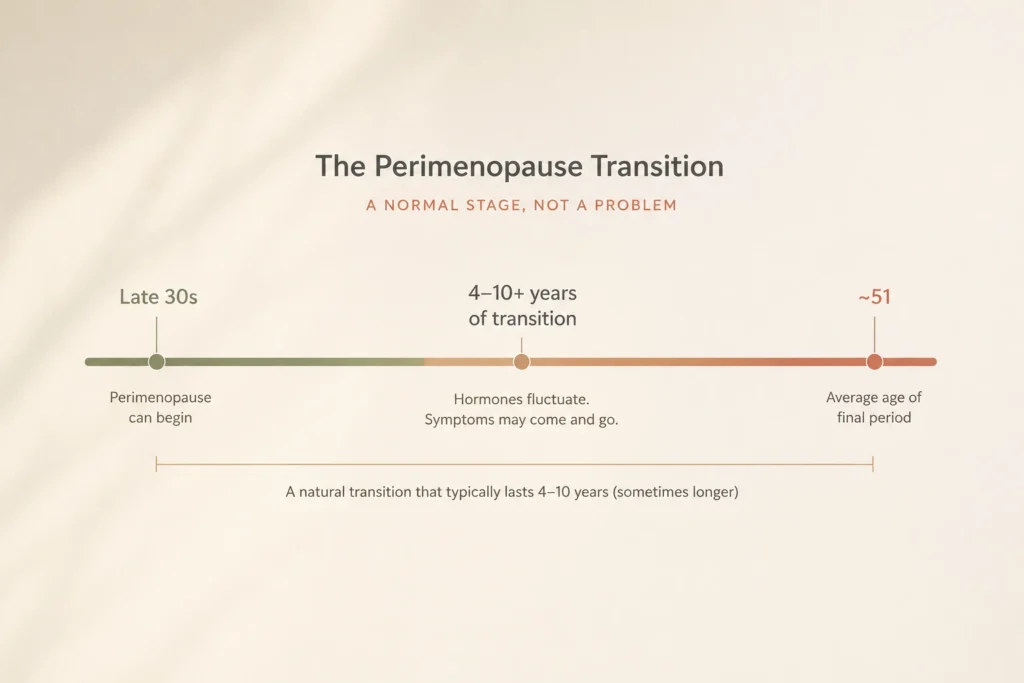
The number everyone knows is 51, the average age of the final menstrual period. The number almost no one tells you, and the one that matters at 38, is this: perimenopause, the transition that leads up to that final period, can last anywhere from four to ten years. For some women, longer.
Do the arithmetic and it stops being surprising. A transition that lasts a decade, ending on average around 51, can begin in the late 30s in a completely ordinary woman with no underlying problem. Thirty-eight is on the earlier side of normal, but it is still normal. It is not early menopause. It is not a medical anomaly. It’s the front edge of a transition the standard menopause narrative skips over entirely.
What makes 38 feel impossible is that the whole cultural script starts at 50 and centers on hot flashes. Nobody hands a 38-year-old anything about the years-long hormonal shift that often begins with anxiety and a wrecked night’s sleep rather than a hot flash. So when it arrives, it doesn’t look like ‘the change.’ It looks like you falling apart for no reason. That mismatch is most of why you doubted yourself enough to need this article, and it’s the same mismatch behind the early signs of perimenopause in your 30s that so many women only recognize in hindsight.
Why You’re Getting Perimenopause Symptoms at 38: What Your Hormones Are Doing
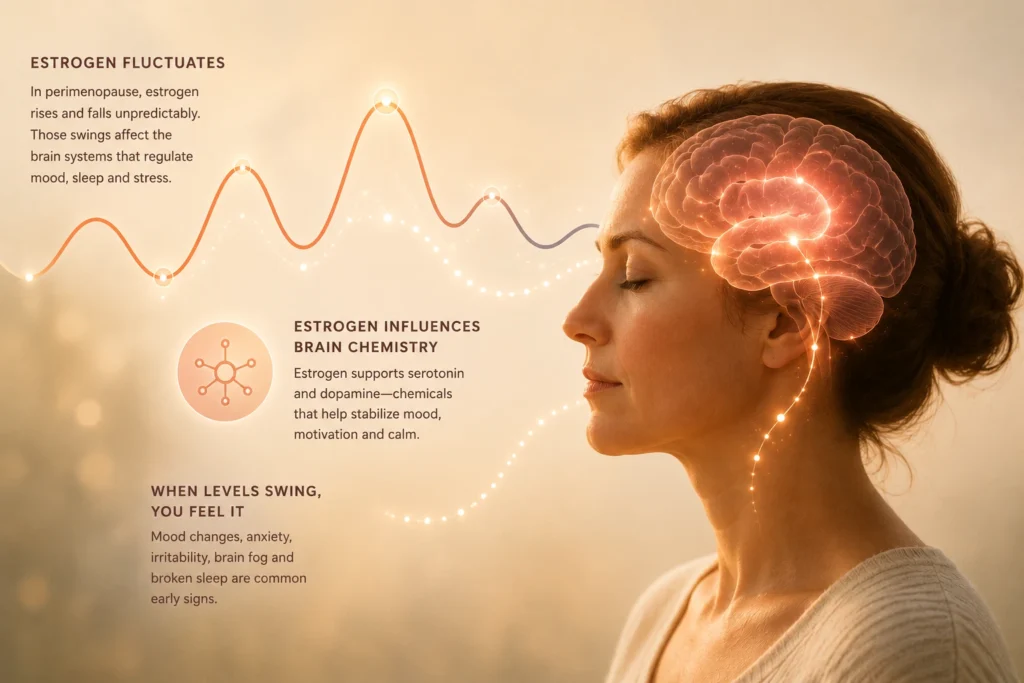
For most of your adult life, your ovaries have run a predictable monthly rhythm, with estrogen and progesterone rising and falling in a pattern reliable enough that your body knew what to expect. Perimenopause is what happens when that rhythm starts to become erratic.
It is not a steady decline, and that’s the part that catches women off guard. Estrogen doesn’t politely taper down; in early perimenopause it swings, sometimes higher than before, sometimes dropping sharply, cycle to cycle and even week to week. Progesterone, which depends on whether you ovulate in a given cycle, often starts dropping earlier than estrogen does. The result is a hormonal environment less predictable than it’s been in twenty years, and your brain and body feel every swing.
Why the first symptoms are so often psychological
Here’s the piece that explains why this gets missed at 38. Estrogen isn’t only a reproductive hormone. It directly influences serotonin, dopamine, and the systems that regulate mood, sleep, and your response to stress. When estrogen fluctuates erratically, those systems fluctuate with it. Progesterone has a natural calming effect on the nervous system; as it declines, that built-in buffer thins out.
Which is why the earliest signs are frequently the ones that don’t look hormonal at all. At 38, perimenopause tends to announce itself as:
- Anxiety that arrives without a reason: often waking you between 2 and 4am with a racing heart and no thought attached to it.
- Mood changes that feel disproportionate: irritability or a flat, heavy low that doesn’t match your circumstances.
- Brain fog: losing words mid-sentence, walking into a room and forgetting why, re-reading the same paragraph.
- Sleep that breaks in the night: falling asleep fine, then waking and being unable to get back.
- Cycle changes: periods becoming heavier, lighter, closer together, or just less predictable than they’ve been for two decades.
These show up before any hot flash, and years before periods stop. They’re also why so many women at this age are told they have an anxiety disorder instead, a mix-up common enough that it has its own explanation in perimenopause vs anxiety: why 40% of women in their 30s are misdiagnosed.
Why Nobody Warned You 38 Was Possible
This isn’t paranoia or bad luck. There’s a structural reason you reached 38 without anyone mentioning this could happen to you.
Perimenopause gets strikingly little time in standard medical training, and what little there is centers on the classic picture: a woman around 50, hot flashes, periods stopped. A 38-year-old with roughly regular periods, normal-looking bloodwork, and symptoms that read as anxiety doesn’t fit that template, so she’s assessed for what she appears to have, and the hormonal possibility never enters the room.
The numbers bear this out. Nearly 40% of women seeking help for what turns out to be perimenopause are misdiagnosed, and more than half are treated for anxiety or depression instead of the hormonal shift driving it. This isn’t a story about negligent doctors. It’s a knowledge gap built into the system, and at 38, you’re sitting squarely in its blind spot.
‘But My Blood Test Was Normal’
If you’ve already seen a doctor, there’s a good chance you were tested, usually FSH (follicle-stimulating hormone), maybe estrogen, and told it was normal. Here’s what that does and doesn’t mean.
In early perimenopause, hormone levels fluctuate dramatically from day to day. FSH can sit in the normal range one week and be elevated the next. A single blood test is a snapshot of one moment in a system that’s changing constantly, so a ‘normal’ result taken on the wrong day tells you very little. It does not mean you’re not in perimenopause. It means that on the day of the draw, that one hormone fell within a wide reference range.
This is why clinicians who actually specialize in perimenopause lean on the pattern of your symptoms over time rather than a single number. A normal FSH at 38, alongside months of cyclical anxiety, broken sleep, and changing periods, is not reassurance that you’re fine. It’s a reason to look at the whole picture instead of one data point.
Is This Early Menopause? The Distinction Worth Understanding
This is the fear underneath the search, so let’s name it directly. Perimenopause at 38 is almost always exactly that: the normal early start of a normal transition. It is not the same as early menopause, and understanding the difference will help you stop catastrophizing at 2am.
- Perimenopause is the transition: the years of fluctuating hormones while you’re still having periods, even if they’re changing. Starting this in your late 30s is within normal range.
- Early menopause refers to periods stopping completely between roughly 40 and 45.
- Premature ovarian insufficiency (POI) is when ovarian function declines significantly before 40. It affects around 1% of women and is a distinct medical situation worth ruling out if your periods have become very infrequent or stopped before 40.
For the large majority of 38-year-olds with the symptom pattern this article describes (still cycling, periods perhaps changing but not gone) this is early perimenopause, not POI. But because POI exists and genuinely benefits from being identified, it’s worth a proper conversation with a doctor rather than self-diagnosis, particularly if your periods have become very irregular, widely spaced, or stopped.
| Worth a prompt appointment if: Your periods have stopped for several months and you’re under 40, you’re having these symptoms while trying to conceive, or anything here feels severe or frightening. A doctor can test properly over time and rule out POI and other causes such as thyroid problems, which can mimic this exact picture. |
What to Do Now

You don’t need to overhaul your life this week. The single most useful first step is also the simplest: start tracking what’s actually happening, because the pattern is the thing that gets you taken seriously.
For the next 30 days, note your symptoms against your cycle: sleep, mood, anxiety, energy, and where you are in your cycle when each shows up. If your worst days cluster in the run-up to your period, that’s a hormonal signature, and it’s exactly the evidence that turns an appointment from ‘I’ve been feeling off’ into ‘here is a documented pattern I’d like to discuss.’ If you’re heading back to a doctor who’s already waved you away once, how to talk to your doctor without being dismissed gives you the exact language that works.
And the second step is simply this: don’t accept ‘you’re too young’ as the end of the conversation. You now know it isn’t true. You’re allowed to go back, ask for the pattern to be looked at properly, and ask for a referral to someone who specializes in this if you’re not being heard.
| Track it before you forget it: Free 30-Day Perimenopause Symptom Tracker Maps your symptoms against your cycle so you walk into your next appointment with a pattern, not just a feeling. Covers the psychological symptoms first: the ones that show up at 38 and get dismissed. Five minutes a day, no account, no spam. [ Download free ] |
You Were Right to Keep Asking
You’re 38, something changed, and the world kept telling you that you were too young for the one explanation that actually fits. You went looking anyway, which means some part of you already trusted your own read of your body over the people who waved it away.
That instinct was right. Perimenopause at 38 is real, it’s normal, and the symptoms that show up first (the anxiety, the sleep, the fog, the mood) are hormonal, documented, and manageable once they’re named. The hard part was never your body. It was getting anyone, including yourself, to believe that what you were feeling had a name. It does. And now you have it.
Related Reading on This Site
- Early signs of perimenopause in your late 30s and early 40s the full symptom picture, including which ones show up first.
- Perimenopause vs anxiety: why 40% of women in their 30s are misdiagnosed if the anxiety piece is the biggest thing you’re dealing with.
- How to talk to your doctor about perimenopause without being dismissed scripts for the appointment that hasn’t gone well yet.
- Should you start HRT in perimenopause? A decision framework once you’re ready to think about treatment options.
- At-home hormone tests for perimenopause 4 options compared if you want a baseline before your next appointment.
This article is for informational purposes only and does not constitute medical advice. Please consult a qualified healthcare provider if you are experiencing symptoms that concern you.