


This article contains affiliate links. If you purchase through our links, we may earn a small commission at no extra cost to you. This does not affect our editorial recommendations.
It’s 3am and you’re awake again. Not anxious about anything in particular, just awake, heart going slightly too fast, staring at the ceiling and doing the maths on how many hours you have left before the kids are up. You’re 39. You have a job you’re good at, people who rely on you, a life that from the outside looks like it’s working. And quietly, for about a year now, you’ve felt like you’re coming apart at a seam nobody else can see.
I know that 3am ceiling. I stared at it for three years before I had a word for what was happening to me.
If you’ve typed *“what does perimenopause feel like in your late 30s”* into a search bar at some ungodly hour, half-expecting to be told you’re too young to be asking, this is me describing it back to you. Not the clinical checklist. The actual texture of it: what perimenopause feels like from the inside, in the body and the head of a woman still holding everything together while privately wondering if she’s losing her mind. You’re not. By the end of this you’ll have language for what you’ve been living, the reason it’s so easily mistaken for everything else, and the one practical step that starts turning it around.
| The short version: Perimenopause in your late 30s rarely feels like “menopause.” It feels like anxiety that arrived from nowhere, sleep that breaks at 3am, a fuse that’s suddenly far too short, and a strange sense of not quite being yourself, all while your periods are still mostly showing up. It feels like being slightly off in a way you can’t point to on a chart. That vagueness is exactly why it gets missed. It’s also exactly what it is. |
It Doesn’t Feel Like What You Were Told It Would
Everything you’ve ever absorbed about “the change” involves a woman older than you, fanning herself, having a hot flash. So when your version shows up as lying awake at 3am with a racing heart and no hot flash in sight, it doesn’t even occur to you they might be the same thing. They don’t look related. One is a punchline in a sitcom. The other is just… you, not coping, for reasons you can’t explain.
That mismatch is the cruelest part of perimenopause in your late 30s. The thing happening to you has a name, a mechanism and a treatment, but it arrives in disguise. It shows up as anxiety, so you think you’ve developed an anxiety disorder. As irritability, so you think you’ve become a worse mother, partner, person. As forgetting words mid-sentence, so a quiet, terrible part of you starts wondering about early dementia.
None of that is what’s happening. What’s happening is hormonal, ordinary, and far more common at your age than anyone told you. In fact perimenopause can begin in your late 30s for completely ordinary reasons, as our guide to the early signs of perimenopause in your late 30s and early 40s lays out. But because it doesn’t feel like the story you were handed, you spend months, sometimes years, looking everywhere except the actual cause.
The Feeling Nobody Names: You Just Don’t Feel Like Yourself

If I had to reduce the whole experience to one sentence, it would be this: you stop feeling like yourself, and you can’t work out why.
It’s not dramatic. That’s what makes it so hard to explain to anyone, including a doctor. You’re not in crisis. You’re functioning: going to work, packing lunches, answering emails, showing up. From the outside, nothing’s wrong. But inside, there’s a low, persistent sense that the volume has been turned down on the person you used to be. The patience you had is gone. The sharpness you relied on at work is intermittent now. The version of you that found things funny, that had energy left at the end of the day, that didn’t cry in the car park over something small: she’s harder to reach.
Women describe this to each other in half-sentences, almost apologetically. “I just don’t feel like me.” “Something’s off and I can’t put my finger on it.” “I feel like I’m watching my life through glass.” It sounds vague because it is, and the vagueness is precisely why it gets waved away. There’s no single symptom to point at, just a pervasive wrongness you can’t turn into a sentence a doctor will take seriously in ten minutes.
Name it anyway. That feeling, having become a muted, shorter-fused, foggier version of yourself, is one of the most reliable early signatures of perimenopause there is. It is not a character flaw. It’s a hormonal shift, and it’s happening in your brain before it ever announces itself in your body.
What the Days Actually Feel Like

Here’s the texture of it: the specific, recognizable moments that, strung together, make up perimenopause in your late 30s. See how many you know from the inside.
The 3am wake-up
You fall asleep fine. The problem is staying asleep. At some point in the small hours, often between 2 and 4am, you snap awake, frequently with your heart going and a flat sense of dread that isn’t attached to any actual thought. You’re not worrying about a specific thing. The anxiety came first; your brain then goes looking for something to pin it on. You lie there for an hour, maybe two, then drag yourself through the next day on a deficit you never fully repay.
The anxiety that has no story
This is the one that fools everyone, including doctors. It’s anxiety without a cause: a humming, physical unease in your chest or stomach for no reason you can identify. It’s worse some weeks than others, which feels random until you notice it tracks your cycle. It’s so easily mistaken for a generalised anxiety disorder that a huge number of women in their late 30s walk out with an antidepressant and no mention of hormones at all, which is exactly the mix-up we unpack in perimenopause vs anxiety: why 40% of women in their 30s are misdiagnosed.
The disproportionate rage
The sudden, hot, out-of-nowhere fury over something small: the spilled drink, the question asked twice, the shoe left on the stairs. You hear yourself snap at the people you love most and think: that wasn’t me. That reaction was three sizes too big for what happened. Then comes the shame, which is almost worse than the anger. It has its own name and mechanism, and it’s one of the most under-discussed parts of the transition. We wrote about perimenopause rage specifically.
The brain fog
Walking into a room and forgetting why. Losing a word you’ve used a thousand times, mid-sentence, in a meeting. Reading the same paragraph three times. For a high-functioning woman whose competence is part of her identity, this one is genuinely frightening, frightening enough that early-dementia fear becomes a real and common 2am spiral. It almost never is dementia. It’s estrogen, fluctuating.
The body keeping score
Weight settling around your middle despite nothing changing in how you eat or move. Periods still arriving but quietly gone rogue: heavier, lighter, closer together, or just less predictable than the clockwork you’ve known for twenty years. Maybe heart palpitations that sent you to a doctor convinced something was wrong with your heart. The physical stuff often arrives after the psychological stuff, the reverse of what the menopause story led you to expect.
If you read those and felt a quiet jolt of recognition, that’s the point. Not every woman gets all of them. But the cluster, and the sense that they arrived around the same time and add up to “I don’t feel like me,” is the pattern. That recognition is the first real piece of evidence you’ve had in a long time that you’re not imagining this.
Why It Feels Psychological Before It Feels Physical
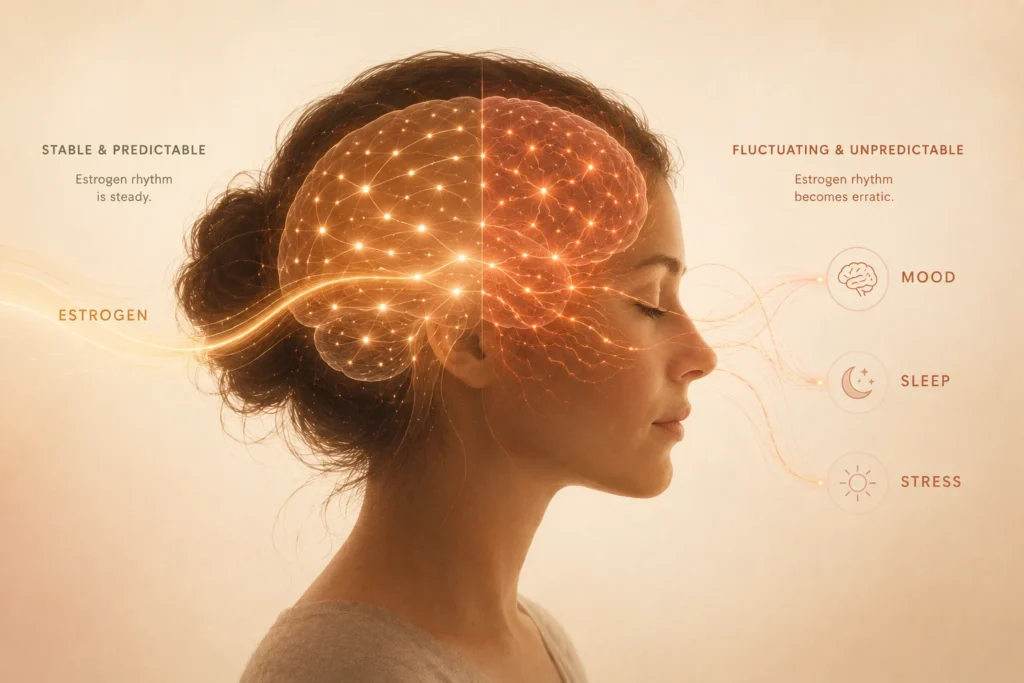
Here’s the part that earns a moment of biology, because understanding it changes how the whole experience feels. Once you know why your brain is doing this, it stops feeling like a personal failing and starts feeling like what it is: a physiological event you happen to be living through.
Estrogen isn’t only a reproductive hormone. It works directly on serotonin, dopamine, and the systems that govern mood, sleep, and how you handle stress. For most of your adult life, estrogen rose and fell in a predictable monthly rhythm and those systems stayed relatively steady. In perimenopause that rhythm becomes erratic: estrogen swings up and down unpredictably rather than gliding. Progesterone, which calms the nervous system, often starts dropping earlier still, thinning out your built-in buffer against stress.
So the mood, the sleep, the anxiety, the fog, the symptoms that feel the least “hormonal,” are actually the ones most directly downstream of fluctuating estrogen. That’s why they come first, often years before a single hot flash, and why they’re the ones most likely to be relabeled as a mental-health problem instead of recognized as the leading edge of a hormonal transition.
Why It Feels Like Nobody Believes You
Because, often, they don’t, and that’s not your imagination either. This is the part that does real damage on top of the symptoms themselves: the slow erosion of trust in your own read of your body.
You go to a doctor because something is wrong. You’re still having periods, so the hormonal possibility gets dismissed before it’s considered. A blood test comes back “normal,” which in early perimenopause it often does, because a single snapshot can’t capture hormones swinging week to week. You’re told you’re too young, or it’s stress, or it’s just a busy season of life. You leave with the distinct impression that the problem might be you: that you’re not coping with a life other women manage fine.
The numbers say otherwise, and they’re worth holding onto at 3am. Nearly 40% of women seeking help for what turns out to be perimenopause are misdiagnosed, and more than half are treated for anxiety or depression instead of the hormonal shift actually driving it. This isn’t a story about bad doctors. It’s a gap built into the system, and at 38, 39, 40, you’re sitting right in the middle of its blind spot. Most women, like me, end up finding the word “perimenopause” themselves, in a forum at 2am, three years later than they should have.
If you’ve been made to feel like the unreliable narrator of your own life, hear this clearly: the instinct that something is wrong is the part of you that’s working correctly. It’s the only part of this story that’s been right the whole time.
What You Can Do With This

You don’t have to overhaul anything this week. The single most useful thing, and the thing that finally turned my own vague “I feel off” into a conversation a doctor couldn’t wave away, is to stop trying to hold it all in your head and start writing it down.
For the next month, track what you’re feeling against where you are in your cycle: the sleep, mood, anxiety, fog, rage, energy. If your worst days cluster in the run-up to your period, that’s a hormonal signature: the exact evidence that changes an appointment from “I’ve been feeling strange” into “here is a documented pattern I’d like to talk about.” The pattern is what gets you taken seriously, and how to talk to your doctor without being dismissed gives you the words for that conversation. A feeling is easy to dismiss. A month of tracked data is not.
| Start with the feeling, before you forget it: free 30-Day Perimenopause Symptom Tracker. Maps the psychological symptoms first (the sleep, the anxiety, the fog, the mood) against your cycle, so the vague “I don’t feel like me” becomes a pattern you can point to. Five minutes a day, no account, no spam. Download free |
You’re Not Imagining It. You Finally Have the Word.
If you came here wondering what perimenopause feels like in your late 30s, the honest answer is: it feels exactly like what you’ve been living. The 3am waking. The anxiety with no story. The short fuse and the shame that follows it. The fog that makes you doubt your own mind. The quiet, persistent sense of not being yourself, while everyone around you, including your doctor, tells you you’re fine and probably just stressed.
You weren’t just stressed. You were at the front edge of a hormonal transition nobody prepared you for, reading your own body more accurately than the people paid to read it for you. I spent three years not knowing that. You don’t have to spend three more. It’s real, it has a name, and now, finally, so do you.
Related Reading on This Site
- Early signs of perimenopause in your late 30s and early 40s the full symptom picture, including which ones show up first.
- Why am I getting perimenopause symptoms at 38? if the age question is the part that keeps nagging at you.
- Perimenopause vs anxiety: why 40% of women in their 30s are misdiagnosed if the anxiety piece is the biggest thing you’re dealing with.
- Perimenopause rage what’s actually happening and the 4 things that actually help if the anger seems to come out of nowhere lately.
- How to talk to your doctor about perimenopause without being dismissed scripts for the appointment that hasn’t gone well yet.
- At-home hormone tests for perimenopause: 4 options compared if you want a baseline before your next appointment.
- Should you start HRT in perimenopause? A decision framework once you’re ready to think about treatment options.
This article is for informational purposes only and does not constitute medical advice. Please consult a qualified healthcare provider if you are experiencing symptoms that concern you.