


This article contains affiliate links. If you purchase through our links, we may earn a small commission at no extra cost to you. This does not affect our editorial recommendations.
You walked into the kitchen and have no idea why. You lost a word mid-sentence in a meeting (a word you’ve used a thousand times) and had to talk around the hole in your own vocabulary while everyone waited. You’ve re-read the same email three times and still couldn’t tell anyone what it said. And underneath the frustration is a colder thought you haven’t said out loud: what if this is the start of something serious?
It almost certainly isn’t. If you’re in your late 30s or early 40s and your memory has started feeling unreliable in a way it never used to, the most likely explanation isn’t early dementia, isn’t burnout, and isn’t you slipping. It’s perimenopause brain fog: a real, documented, hormonally-driven symptom that frightens women precisely because no one warns them it’s coming. Here’s what’s actually happening in your brain, why it’s happening now, when it’s genuinely worth getting checked, and what actually helps.
| The short answer: Perimenopause brain fog (word-finding blanks, forgetfulness, trouble concentrating, that “thinking through treacle” feeling) is caused by fluctuating estrogen, which your brain depends on for memory and focus. It’s extremely common in your late 30s and 40s, it’s almost never dementia, and for most women it improves. The fear it triggers is the worst part; the symptom itself is manageable once you know what it is. |
What Perimenopause Brain Fog Actually Is
“Brain fog” isn’t a medical diagnosis. It’s the everyday name women give to a specific cluster of cognitive symptoms that show up together during the hormonal transition. If you’ve been living with it, you’ll recognize the list immediately:
- Word-finding difficulty: the word is right there, on the tip of your tongue, and it won’t come. Names, especially.
- Short-term memory lapses: walking into a room and forgetting why, losing your train of thought mid-sentence, forgetting appointments you’d normally never miss.
- Trouble concentrating: reading the same paragraph repeatedly, struggling to hold focus on a task that used to be automatic.
- Mental slowness: thinking through treacle, your processing speed dropped, a beat behind where you used to be.
- Multitasking falling apart: the juggling you used to do without thinking now drops balls.
For a woman whose competence and sharpness are part of who she is, often while holding down a demanding job, a household, and aging parents at once, this is no minor annoyance. It strikes at your sense of yourself, which is why it generates more quiet fear than almost any other perimenopause symptom.
Why It’s Happening: Your Brain Runs on Estrogen
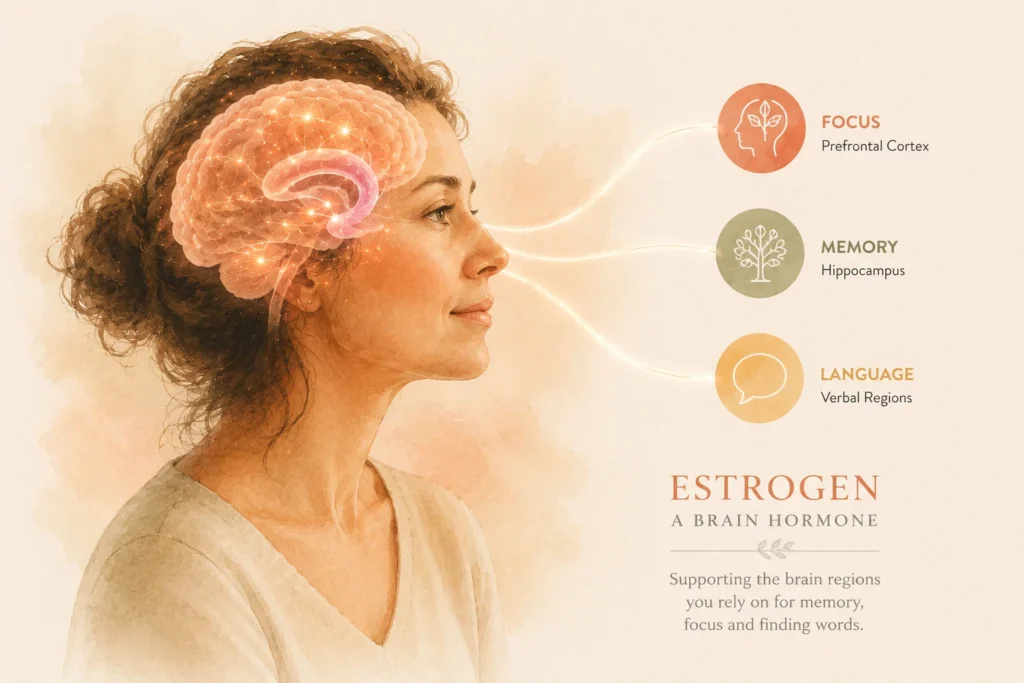
Here’s the piece that reframes everything, and the reason this is nothing to be ashamed of. Estrogen isn’t just a reproductive hormone. It’s a brain hormone. Your brain is full of estrogen receptors, particularly in the regions responsible for memory and verbal fluency, and estrogen helps regulate the neurotransmitters and energy use those regions rely on to work smoothly.
For most of your adult life, estrogen rose and fell in a steady monthly rhythm and your cognition stayed reliable. In perimenopause that rhythm becomes erratic: estrogen swings up and down unpredictably from week to week rather than gliding. Your brain, calibrated to steady levels, now has to operate on a fluctuating supply. The result, for many women, is exactly the cluster above: the memory hiccups, the word-finding blanks, the dropped focus.
Two things make it worse, and they’re worth naming because they’re fixable. First, sleep: perimenopause wrecks it (the 3am waking, the night sweats) and nothing degrades memory and concentration faster than chronic broken sleep. Second, the anxiety and mental load that so often arrive at the same time, which independently eat the working-memory capacity you’d otherwise use to think clearly. (That anxiety is its own hallmark symptom, covered in perimenopause vs anxiety.) Brain fog is frequently estrogen, poor sleep, and a stressed nervous system compounding each other.
| The key reassurance: Research on cognition across the menopause transition consistently finds this is a genuine but largely temporary dip tied to the hormonal shift, not a sign of permanent decline, and not an early marker of dementia. The fog is your brain adjusting to a moving target, not failing. |
“Is This Early Dementia?” The Fear Worth Addressing Directly
Let’s name the 2am thought, because pretending it isn’t there doesn’t help. When you can’t find a word or you forget why you walked into a room, the mind jumps to the worst case, especially if you’ve watched a parent go through cognitive decline. So here’s the honest distinction. Tap through the sections below for the broad pattern; it’s orientation, not a diagnostic tool.
Perimenopause brain fog: Where you put your keys; why you came into a room; a word that returns later
Cause for a closer look: Forgetting how to use familiar objects, or getting lost in familiar places
Perimenopause brain fog: You’re acutely aware of it and frustrated by it
Cause for a closer look: Reduced awareness anything is wrong (often noticed by others first)
Perimenopause brain fog: On the tip of your tongue, comes back later
Cause for a closer look: Substituting wrong words so sentences are hard to follow
Perimenopause brain fog: Fluctuates with cycle, sleep and stress; tends to improve
Cause for a closer look: Steady, progressive worsening over time
Perimenopause brain fog: Tracks the hormonal transition, alongside sleep and mood changes
Cause for a closer look: Not tied to cycle or sleep; happens independently
The reassuring reality: perimenopause-related cognitive change typically fluctuates, comes packaged with the other transition symptoms (sleep, mood, cycle changes), and you’re painfully aware of it, which is itself a good sign. Progressive, worsening memory loss that family notice before you do, or that disrupts familiar tasks, is a different picture and worth a prompt medical conversation. If anything here genuinely worries you, get it checked; peace of mind is a legitimate reason to see a doctor.
What Actually Helps Perimenopause Brain Fog

The good news is that brain fog responds to intervention, often more readily than women expect, because so much of it is downstream of fixable things like sleep and erratic hormones. Here’s what genuinely moves the needle, simplest first.
Fix the sleep first
This is the single highest-leverage thing you can do, because broken sleep amplifies every cognitive symptom, so if 3am waking is wrecking your nights, addressing that often lifts the fog more than anything else. Magnesium glycinate is the common, low-risk first step many women start with for perimenopausal sleep; our 90-day test of the best magnesium for perimenopause sleep breaks down why it helps and how to use it before you buy anything. Protecting your sleep window, cutting late caffeine and alcohol (both far more disruptive now than they used to be), and a consistent wind-down all compound.
Reduce the cognitive load you’re carrying
You can’t out-supplement a brain running a dozen open tabs on no sleep. Externalize everything you can (lists, calendars, reminders, one capture place for everything) so you’re not spending scarce working memory holding appointments in your head. This isn’t a workaround to be embarrassed about; it’s how you support a fluctuating brain right now.
Move your body and feed your brain
Regular exercise, especially anything that raises your heart rate, has some of the best evidence of anything for cognition and mood, partly through better sleep and blood flow to the brain. Protein, omega-3s, and stable blood sugar steady the energy supply your brain is working with. None of it is dramatic alone; together, consistently, it shifts the baseline.
Consider whether it’s time to treat the hormones directly
When the fog is significant, persists despite the basics, and arrives alongside the transition’s other disruptive symptoms, treating the underlying hormonal fluctuation becomes a reasonable conversation. Hormone therapy isn’t a guaranteed fix for cognition specifically, but by steadying estrogen and improving sleep it often lifts the fog as part of the broader improvement many women report. Whether it’s right for you depends on your full picture: our HRT decision framework for women in their late 30s and 40s walks through it so you’re not deciding in the dark. The point is simply that you have options beyond white-knuckling it.
| See the pattern before you forget it: free 30-Day Perimenopause Symptom Tracker. Maps your cognitive symptoms against your cycle and sleep, so you can see whether the fog tracks your hormones, and walk into an appointment with a documented pattern instead of “I feel forgetful lately.” Five minutes a day, no account, no spam. Download free |
Common Questions
Is perimenopause brain fog permanent?
For the large majority of women, no. The cognitive dip tied to the menopause transition is generally temporary: it tracks the period of greatest hormonal fluctuation and eases as the body settles. Addressing sleep, stress, and where appropriate the hormones themselves usually improves it well before then.
Can perimenopause cause memory loss in your late 30s?
Yes. Because perimenopause can begin in the late 30s, the cognitive symptoms can too, and at that age they’re especially likely to be dismissed as stress, because no one expects perimenopause this early. Forgetfulness and word-finding trouble at 38 or 39, alongside changes in sleep, mood or cycle, fit the perimenopause picture far more often than anything sinister.
How do I know if it’s brain fog or something more serious?
The broad pattern is the guide: perimenopause fog fluctuates, comes with the other transition symptoms, and you’re acutely aware of it. Memory loss that progressively worsens, that others notice before you do, or that interferes with familiar everyday tasks warrants a prompt medical check. When in doubt, getting checked is always reasonable.
Does HRT help with brain fog?
It can, though not as a targeted “cognitive” treatment. By stabilizing estrogen and often dramatically improving sleep, HRT tends to lift brain fog as part of the wider improvement many women report. Whether it’s right for you is an individual decision worth thinking through properly rather than as a quick fix.
You’re Not Losing Your Mind, You’re Losing Estrogen

The fog is real. The forgetting is real. The word that won’t come when you need it is real, and so is the fear underneath it. But the story your mind reaches for at 2am (that you’re slipping, declining, becoming less) is almost certainly wrong.
What’s actually happening is that a brain built to run on steady estrogen is adjusting to a supply gone erratic, on too little sleep, while you carry more than most people realize. That’s not decline. It’s a transition: one with a mechanism, a name, and real things that help. You haven’t lost your sharpness for good. You’ve found another symptom of the thing nobody warned you about. And now you know what it is.
Related Reading on This Site
- Early signs of perimenopause in your late 30s and early 40s the full symptom picture, including which ones show up first.
- What perimenopause actually feels like in your late 30s what it’s actually like day to day, beyond just the early warning signs.
- Perimenopause vs anxiety: why 40% of women in their 30s are misdiagnosed if the anxiety piece is the biggest thing you’re dealing with.
- The best magnesium for perimenopause sleep if sleep is the piece that’s falling apart first.
- Should you start HRT in perimenopause? A decision framework once you’re ready to think about treatment options.
- How to talk to your doctor about perimenopause without being dismissed scripts for the appointment that hasn’t gone well yet.
- At-home hormone tests for perimenopause: 4 options compared if you want a baseline before your next appointment.
This article is for informational purposes only and does not constitute medical advice. Please consult a qualified healthcare provider if you are experiencing symptoms that concern you.