


This article contains affiliate links. If you purchase through our links, we may earn a small commission at no extra cost to you. This does not affect our editorial recommendations.
If you’re reading this at 3am because you woke up again, and again, with your brain already running the full to-do list, this is probably not your first time Googling something like this.
I did the same thing for fourteen months. The jolts woke me at 2:47am: heart slightly racing, mind immediately alert, body absolutely exhausted. My doctor said stress. My thyroid was fine. My sleep hygiene was, genuinely, excellent. What no one told me was that this exact pattern (falling asleep fine, waking in the night, unable to return) is a specific perimenopause sleep failure mode driven by a specific hormonal shift. And that magnesium, the right form, directly targets it.
I tested three forms over 90 days, tracked every night with an Oura Ring, and I’m going to give you the honest version: what reduced my 3am wake-ups from five nights a week to one, which form didn’t work as well as expected, and the dosing mistake I made in week one that almost made me give up.
By the end of this article you’ll know exactly which form to buy, which to skip, and how to take it so it actually works.
| Quick answer: best magnesium for perimenopause sleep Best overall for sleep maintenance: Pure Encapsulations Magnesium Glycinate: 400 mg elemental, pharmaceutical-grade, no fillers. Targets the 3am wake pattern specifically. Best if brain fog or anxiety are also significant: Thorne Magnesium Bisglycinate: gentler on the stomach, slightly better brain absorption. Best if cognitive symptoms dominate: Life Extension Neuro-Mag (L-Threonate): the only form proven to meaningfully cross the blood-brain barrier. Skip entirely: magnesium oxide (most cheap supplements), magnesium citrate, underdosed gummy blends. |
At a Glance: Best Magnesium for Perimenopause Sleep, Compared
Form: Glycinate
Elemental dose: 400 mg
Third-party tested: USP Verified
Best for: Sleep maintenance and muscle relaxation
Approximate 30-day cost: $28
Form: Bisglycinate
Elemental dose: 200 mg twice daily (400 mg total)
Third-party tested: NSF Certified
Best for: Sleep support, brain fog, and people with sensitive digestion
Approximate 30-day cost: $32
Form: Magnesium L-Threonate
Elemental dose: 144 mg
Third-party tested: In-house testing
Best for: Sleep support, cognitive symptoms, and anxiety-related concerns
Approximate 30-day cost: $38
Form: Glycinate
Elemental dose: 200 mg
Third-party tested: USP Verified
Best for: Budget-conscious shoppers or those who want to start with a lower dose
Approximate 30-day cost: $18
Form: Mixed magnesium forms, often including magnesium oxide
Elemental dose: Frequently unclear or not fully disclosed
Third-party tested: Rarely verified
Best for: Not recommended
Approximate 30-day cost: Varies
Why it’s not recommended: Product quality, absorption, and ingredient transparency can vary significantly between brands.
Why Perimenopause Specifically Destroys Your Sleep
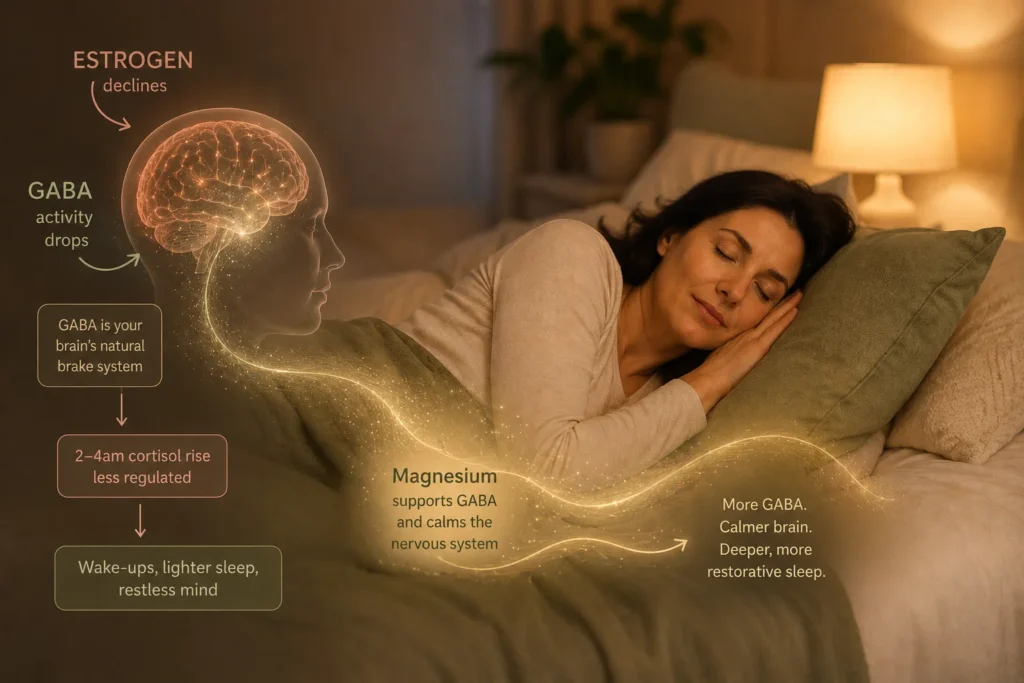
Most sleep advice treats insomnia as a single problem with a single fix: melatonin, sleep hygiene, cut the screens. For perimenopausal women, the mechanism is more specific, and understanding it changes what you take.
The hormonal cascade nobody explains
Estrogen directly regulates GABA: the brain’s primary inhibitory neurotransmitter, the one responsible for keeping the nervous system quiet overnight. When estrogen fluctuates and declines in perimenopause, GABA activity drops with it.
At the same time, declining progesterone reduces levels of allopregnanolone (the calming compound your brain makes from progesterone), which compounds the GABA problem from a second direction. Two of the hormones that help your nervous system stay quiet overnight are both declining simultaneously.
The result is a specific sleep failure mode: falling asleep is often fine, but staying asleep, particularly through the 2–4am window when cortisol begins its early-morning rise, becomes unreliable. In a properly buffered nervous system, that cortisol rise is gentle. In a perimenopausal system with depleted GABA support, it triggers a full wake event. Sleep-maintenance insomnia, not sleep-onset insomnia.
Why melatonin usually doesn’t fix this
Melatonin addresses sleep onset: difficulty falling asleep. It has minimal effect on sleep maintenance. If your GP recommended melatonin and it did nothing, this is probably why: you’re targeting the wrong mechanism. Magnesium, specifically glycinate and threonate, directly supports GABA activity and cortisol regulation. It targets the specific failure mode rather than sedating the onset.
This doesn’t mean magnesium is a complete solution for everyone. For women with significant hormone decline, it’s a support tool, not a substitute for addressing the underlying hormonal picture. If you’re considering whether HRT might be appropriate, our HRT decision framework for women in their 30s and 40s walks through that question in full.
The Three Forms That Actually Matter for Perimenopause Sleep

There are eight or nine forms of magnesium on the market. For perimenopause sleep specifically, three are worth your money. Before the breakdown, a quick decision guide:
| Which form is right for you? Waking in the night, muscle tension, restlessness → magnesium glycinate (400 mg elemental)Sleep disruption + daytime brain fog or anxiety → magnesium threonate or bisglycinate GI-sensitive, or want maximum absorption per capsule → magnesium bisglycinate Already on HRT and sleep still disrupted → glycinate at 200–300 mg (estrogen improves magnesium retention, so your effective dose is typically lower) |
Magnesium glycinate: the sleep-maintenance specialist
Glycinate is magnesium bound to glycine, an amino acid with its own independent calming properties. Glycine supports GABA through a separate pathway from the magnesium itself, so you get a dual mechanism: magnesium supporting GABA directly, glycine supporting it from a different angle simultaneously.
High bioavailability, minimal GI upset at therapeutic doses, and the most-studied form specifically for sleep quality in adult women. It doesn’t cross the blood-brain barrier as efficiently as threonate (a real limitation if cognitive symptoms are prominent) but for pure sleep maintenance, it’s the best-evidenced option.
Best for: women whose primary complaint is waking in the night, muscle tension, or restlessness during sleep.
Therapeutic dose for perimenopause: 300–400 mg elemental. Most standard products are 200 mg, insufficient for many women in this demographic. Check the label for elemental dose, not compound weight.
Timeline: allow 2–3 weeks minimum. Magnesium builds in the body; the first few nights are not a reliable indicator.
Magnesium threonate: the brain-fog-and-sleep option
Threonate is the only form proven in clinical research to meaningfully raise brain magnesium levels. Developed at MIT, it was specifically designed to cross the blood-brain barrier rather than stay in peripheral circulation.
For perimenopause, this matters because sleep disruption often arrives packaged with anxiety, brain fog, and cognitive symptoms, all influenced by brain magnesium specifically. If your sleep problems are entangled with daytime anxiety and difficulty concentrating, threonate earns its premium price.
Best for: women dealing with sleep disruption alongside significant brain fog, anxiety, or the ‘wired but tired’ pattern.
Honest cost note: threonate is ~$38/month vs ~$28 for glycinate. If cost is a constraint, glycinate at 400 mg elemental will get you roughly 80% of the sleep benefit. Start with glycinate; add or switch to threonate if cognitive symptoms remain.
Elemental dose note: threonate delivers lower elemental magnesium (typically 144–200 mg). Some women take both forms: glycinate for sleep maintenance, threonate as daytime cognitive support.
Magnesium bisglycinate: high absorption, gentlest on the stomach
Bisglycinate is glycinate in a more concentrated form: two glycine molecules per magnesium atom rather than one. Higher elemental magnesium per capsule, marginally better absorption, and the gentlest form on the digestive system. If you’ve found other forms cause loose stools or GI discomfort, bisglycinate is the right form. For sleep purposes, outcomes are comparable to glycinate; the distinction matters mainly if you’re GI-sensitive or want to reach 400 mg elemental without taking multiple capsules.
The two forms to skip, and why
Magnesium oxide: bioavailability approximately 4%. Most of what you take exits unabsorbed. It’s the most common form in cheap supplement blends, which is why so many women have ‘tried magnesium and it didn’t work.’ Put it back on the shelf.
Magnesium citrate: good bioavailability, but works primarily as a gentle laxative. Useful for constipation; not for the nervous-system sleep mechanism you’re targeting.
What I Actually Found After 90 Days
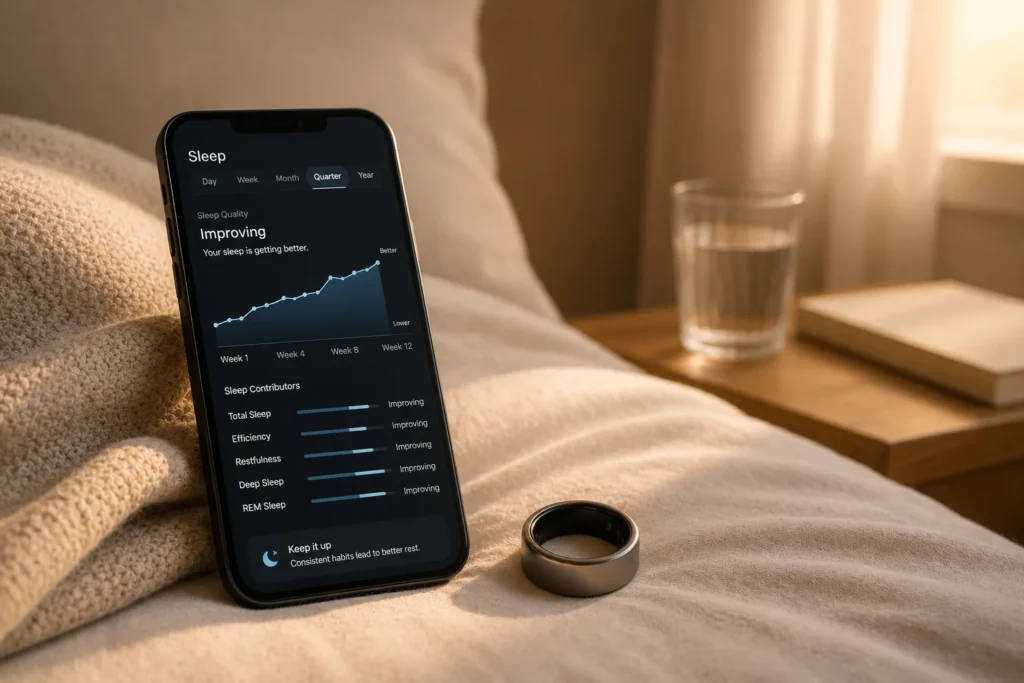
Upfront caveat: this is an n=1 personal experiment tracked with an Oura Ring, not a clinical trial. I tracked sleep efficiency (time asleep vs. time in bed), deep-sleep duration, and wake events in the 2–4am window. Everything else was held constant: same bedtime window, same low alcohol intake, same exercise pattern. What changed was the magnesium form every four weeks.
Weeks 1–4: Pure Encapsulations Magnesium Glycinate (400 mg elemental)
Week one felt like nothing. I almost stopped. Week two: waking once in the night instead of two or three times. Weeks three and four: 3am wake events dropped from five or six nights per week to one or two.
Sleep data: sleep efficiency 74% → 83%. Deep sleep up roughly 18 minutes per night on average by week four.
One unexpected finding: even on the nights I did wake, the quality of the waking changed. Less cortisol-spike feeling, more of a quiet surface. I noticed this before the data confirmed it.
Side effect to note: vivid, slightly strange dreams in weeks one and two. Settled completely by week three. This is documented in forums and it’s real. Starting at 200 mg and building up slowly reduces it.
Weeks 5–8: Life Extension Neuro-Mag (L-Threonate, 144 mg elemental)
Sleep metrics were similar to the end of the glycinate period. Not dramatically better for pure sleep maintenance. What I did not expect: daytime anxiety dropped noticeably by week six. A low-level hum I’d attributed to work pressure quieted. Afternoon concentration improved. This was the most significant unexpected finding of the 90 days.
Conclusion: if your sleep disruption comes packaged with daytime anxiety and cognitive symptoms, threonate is worth the premium for those effects specifically. For sleep alone, it doesn’t outperform glycinate enough to justify the extra cost.
Weeks 9–12: Thorne Magnesium Bisglycinate (200 mg ×2 = 400 mg elemental)
Sleep outcomes essentially equivalent to the glycinate period. Marginally better GI experience, though glycinate had already been gentle for me.
Key finding: effectiveness at 400 mg was noticeably better than at 200 mg. The elemental dose matters more than the glycinate-vs-bisglycinate distinction at equivalent doses.
What I kept using after the test
Pure Encapsulations Magnesium Glycinate (400 mg) most nights, swapped to Thorne Bisglycinate during higher-stress periods. If brain fog were my dominant complaint alongside sleep, I’d start with Thorne and reassess at 60 days.
The Brands Worth Buying (And How to Read a Label)
The supplement market has a labeling problem. A product can say ‘Magnesium Glycinate’ on the front while listing compound weight (not elemental magnesium), or blend in cheaper forms like oxide without clear disclosure. Here’s how to read past it.
| How to read a magnesium label Find ‘elemental magnesium’: the label should state how many mg of actual magnesium you’re getting. If it only lists compound weight (e.g. ‘500 mg magnesium glycinate’), the elemental magnesium is roughly 14% of that, about 70 mg. Not therapeutic. Check the other ingredients: if magnesium oxide appears as a secondary source, it’s diluting your effective dose. Put it back. Look for third-party testing: USP Verified, NSF Certified, or Informed Sport on the label confirms the product contains what it claims. Pure Encapsulations and Thorne both pass. |
Recommended brands
Pure Encapsulations Magnesium Glycinate: pharmaceutical-grade, no fillers, USP verified, clearly states 400 mg elemental per serving. About $28 for 180 capsules ($0.31 per 400 mg dose). First recommendation for most women.
Thorne Magnesium Bisglycinate: NSF Certified. Available in powder form if you want to titrate dose precisely in the first two weeks. ~$32/month. First recommendation if GI sensitivity is a concern.
Life Extension Neuro-Mag (L-Threonate): the most credible threonate formulation available, based on the original MIT-derived research. ~$38/month. Recommended only if cognitive symptoms are prominent alongside sleep disruption.
Nature Made Magnesium Glycinate: USP verified, budget-friendly at ~$18/month, but 200 mg elemental per serving, so you’ll need two capsules to reach a therapeutic dose. Acceptable if cost is the primary constraint.
What to avoid: gummy formats (typically 50–100 mg elemental plus added sugars that spike blood glucose and worsen sleep), generic ‘magnesium complex’ blends with unlabeled elemental dose, and any product where oxide or citrate is the primary magnesium source.
The Protocol I Follow (And What to Do If It Stops Working)
Timing
Take magnesium 60–90 minutes before your intended sleep time, not at lights-out. The GABA-supporting process takes time to engage. Most women who report magnesium ‘not working’ are taking it too late.
Dose
Start at 200 mg elemental for the first week. If no GI issues, increase to 300 mg in week two, then 400 mg in week three if needed. The 300–400 mg elemental range is where most perimenopausal women find the sleep effect.
If you’re already on HRT: estrogen therapy improves magnesium retention, which means 200–300 mg may be sufficient. Start at 200 mg and assess over three weeks before increasing.
If results plateau or stop after 3–4 weeks
- You may have corrected your body’s magnesium deficit. The dramatic early effects often come from repletion. Dropping to a maintenance dose of 200 mg and monitoring is a reasonable next step.
- Try shifting timing to 90 minutes before bed instead of 60, a small change that makes a noticeable difference for some women.
- If you were on glycinate, trial threonate for four weeks, particularly if daytime cognitive symptoms have persisted.
- If symptoms are worsening despite continued magnesium use, that’s a signal worth investigating with a clinician. Magnesium addresses the GABA side of perimenopause sleep; it doesn’t address significant underlying hormone decline.
| Protocol at a glance Form: glycinate or bisglycinate for sleep. Add or switch to threonate if brain fog + anxiety are prominent. Dose: 200 mg elemental week 1 → 300 mg week 2 → 400 mg week 3 if needed. 200–300 mg if already on HRT. Timing: 60–90 minutes before sleep. Not at lights-out. Assessment window: minimum 3 weeks. Reliable read at 6 weeks. |
Is Magnesium Safe With HRT or Other Medications?
With HRT (estrogen, progesterone, testosterone)
No significant interactions documented at therapeutic doses. Estrogen therapy actually improves magnesium retention, so women on HRT may find lower doses are effective. This isn’t a reason to avoid supplementation, simply a reason to start lower and assess over three weeks before increasing.
| ⚠ Thyroid medication: important timing note. If you take levothyroxine (Synthroid) or any thyroid medication: take it on an empty stomach in the morning and your magnesium in the evening before bed. Magnesium can reduce thyroid-medication absorption if taken simultaneously. A 4+ hour separation eliminates this concern entirely. |
With antidepressants (SSRIs, SNRIs)
No significant pharmacological interaction. Magnesium glycinate does not affect the serotonin-reuptake mechanism. If you’re on an antidepressant primarily because your doctor attributed perimenopause symptoms to depression or anxiety, that is a separate conversation worth having with your prescriber, particularly if HRT is something you’re exploring.
With bisphosphonates (Fosamax, Actonel)
Magnesium can reduce bisphosphonate absorption. Separate by at least two hours, and confirm timing with your prescriber.
This section is informational only and does not constitute medical advice. If you have specific concerns about interactions with your medications, speak with your prescribing doctor or pharmacist before starting supplementation.
Frequently Asked Questions
How long before I know if it’s working?
Give it three weeks minimum. Magnesium builds in the body; the first few nights are not representative. Most women who report it not working gave it less than a week. If there’s no change at four weeks, check your elemental dose (it may be too low) or switch from glycinate to threonate.
Can I take magnesium every night long-term?
Yes. Unlike sleep medications, magnesium doesn’t cause dependency or tolerance. Long-term daily supplementation is considered safe for healthy adults at these doses. If you’re taking above 400 mg elemental daily, periodic magnesium testing is a sensible check, though hypermagnesemia from oral supplementation is rare.
Why am I having vivid dreams?
Common in the first one to two weeks of glycinate supplementation: the glycine component has mild psychoactive properties at higher doses. Not dangerous, just surprising. It settles by week three for most women. If it bothers you, start at 150–200 mg and build up over two to three weeks.
My doctor says magnesium won’t help with sleep. Should I trust that?
The population-level evidence on magnesium for sleep is mixed, which is likely what your doctor is referencing. However, the specific research on magnesium for sleep in peri- and post-menopausal women shows stronger signals, likely because this population has both magnesium depletion (estrogen helps with retention) and specific GABA-related sleep disruption. The general-population evidence doesn’t capture your specific physiological situation.
Should I take magnesium if I’m already considering HRT?
These are not mutually exclusive. Magnesium addresses the nervous-system and GABA side of sleep disruption; HRT addresses the underlying hormonal picture. Many women do both. If you’re working through whether HRT is the right next step, our decision framework for starting HRT in perimenopause covers the question in full.
I’m already on HRT, do I still need magnesium?
Possibly. HRT restores estrogen and progesterone levels, which does improve GABA function and magnesium retention; some women on HRT find their sleep resolves without additional supplementation. Others, particularly those who started HRT later in the transition or on lower doses, find magnesium at 200–300 mg provides meaningful additional sleep benefit. If sleep is still disrupted after 8–12 weeks on HRT, magnesium is a low-risk next step to trial.
The Verdict
If you’ve been waking at 3am for months and been told it’s stress, anxiety, or just your age, it’s not just that. It’s a specific hormonal mechanism driving a specific sleep failure mode, and magnesium in the right form is one of the most evidence-aligned, low-risk interventions available for exactly this problem.
The form, dose, and timing matter enormously. Glycinate for most women. Threonate if cognitive symptoms are prominent. 300–400 mg elemental, not 200 mg. Sixty to ninety minutes before bed, not at lights-out. And a minimum of three weeks before you judge it.
After 90 days of testing, my 3am wake events went from five or six nights per week to one or two. For women over 40 with this specific sleep pattern, that result, achieved with a $28 supplement that’s safe alongside most medications, is worth the trial.
| Our recommendation For most women: Pure Encapsulations Magnesium Glycinate: 400 mg elemental, third-party tested, no fillers. Start here. If brain fog + anxiety are significant: Thorne Magnesium Bisglycinate: gentler, slightly better cognitive benefit. If you’re not seeing results after 4 weeks: check elemental dose (aim for 400 mg), shift timing to 90 minutes before bed, then trial threonate for 4 weeks. If sleep disruption is significantly affecting your quality of life: magnesium is a support tool, not a substitute for addressing significant hormone decline. Our HRT decision framework is the logical next step. |
Related Reading on This Site.
- Perimenopause rage: what’s actually happening and the 4 things that actually help. Magnesium is one of the four, but this article covers the full picture.
- Perimenopause vs anxiety: why 40% of women in their 30s are misdiagnosed. If the anxiety symptoms feel more prominent than the sleep issues.
- At-home hormone tests for perimenopause: 4 options compared. For if you want lab data before deciding on your next step.
- Midi vs Alloy vs Winona: full 2026 comparison, for when you’re ready to explore specialist care.
This article is for informational purposes only and does not constitute medical advice. Please consult a qualified healthcare provider before starting any new supplement regimen.
Affiliate disclosure: this article contains affiliate links (the magnesium product recommendations). We may earn a commission at no additional cost to you if you purchase through them. This does not influence our recommendations; we only recommend products we have tested or thoroughly researched.