


This article contains affiliate links. If you purchase through our links, we may earn a small commission at no extra cost to you. This does not affect our editorial recommendations.
HRT vs the Pill is the question a lot of women end up asking after a visit like this one: you went to your doctor with the brain fog, the broken sleep, the mood swings, the periods that have started doing their own thing, and walked out with a prescription for the birth control pill.
You went to your doctor with the brain fog, the broken sleep, the mood swings, the periods that have started doing their own thing, and walked out with a prescription for the birth control pill. Maybe it was the pill you came off years ago. And something about it didn’t sit right: you weren’t asking for contraception, you were asking for help with what felt like a hormonal unraveling. So now you’re wondering whether the pill is actually the right answer, or whether you should be asking about HRT instead.
It’s a fair question, and an underexplained one. Both the pill and HRT can ease perimenopause symptoms, but they’re built for different jobs, use different doses, and suit different women. Here’s the honest comparison: why the pill gets handed out by default, when it’s genuinely the better choice, and when HRT is what you should be asking about instead.
| The short answer: The pill uses higher doses of synthetic hormones to override your cycle and prevent pregnancy, useful in earlier perimenopause, especially if you still need contraception or have heavy, erratic bleeding. HRT uses lower, often body-identical doses to top up what’s declining, and is generally the better fit as you move further into the transition and symptom relief (not contraception) is the goal. Neither is ‘right’ in the abstract, but if no one even mentioned HRT as an option, that’s worth going back about. |
Still working out whether to treat at all? Our HRT decision framework walks through the whole question. Not sure this is even perimenopause? Start with the early signs of perimenopause in your late 30s and early 40s.
The Core Difference: Override vs Top-Up
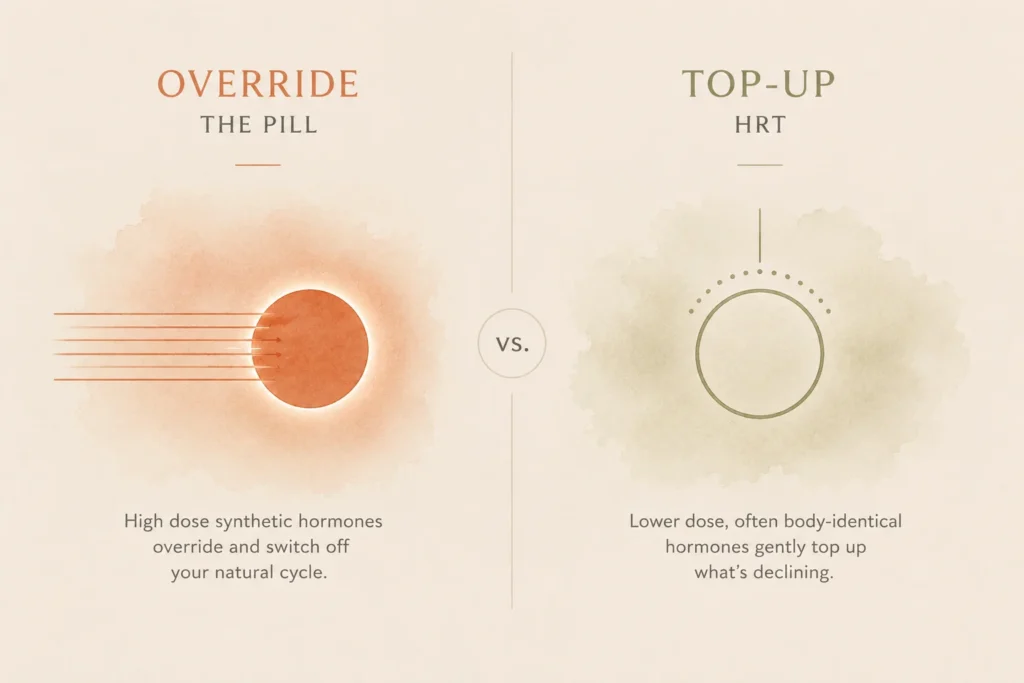
Both treatments contain estrogen and a progestogen, which is why they get talked about as interchangeable. They’re not. The difference is in the dose and the goal, and once you see it, the whole decision gets clearer.
The pill overrides your hormones. Combined oral contraceptives use synthetic hormones (typically ethinyl estradiol, an estrogen several times more potent than what’s in HRT) at doses high enough to suppress ovulation entirely. It switches off your own fluctuating cycle and replaces it with a steady, stronger external supply. That’s great for stopping the swings and preventing pregnancy, but it’s a bigger hormonal intervention than symptom relief alone requires.
HRT tops your hormones up. Hormone therapy uses lower doses (often body-identical estradiol and micronized progesterone) to replenish what’s declining rather than to shut your system down. It doesn’t suppress ovulation, which is also why it isn’t contraception: you can still get pregnant on HRT. The aim is to smooth the deficit, not to take over the controls.
That single distinction, override versus top-up, drives almost everything else: who each suits, what the risks look like, and why the pill can sometimes make you feel worse if your own hormone levels are still running high on some days.
Why the Pill Gets Offered by Default (Even When You Didn’t Ask)

Here’s the part that explains your gut feeling in the appointment. There are real clinical reasons the pill is a reasonable first move in perimenopause, and a less flattering structural reason it’s reached for so automatically.
The legitimate reasons: in earlier perimenopause your own estrogen is often still high and erratically swinging, so adding low-dose HRT on top can occasionally make things worse, while the pill’s stronger, steady dose can flatten the chaos. The pill also reliably controls heavy or unpredictable bleeding and provides contraception, which still matters: you can absolutely still get pregnant in your late 30s and 40s. Major bodies like The Menopause Society and ACOG do support low-dose combined pills for healthy, non-smoking women in this age group who need both symptom relief and contraception.
The less flattering reason: many primary-care doctors are far more comfortable and familiar with prescribing the pill than with menopause hormone therapy, which gets very little time in standard training. So the pill becomes the reflexive answer, not because it was weighed against HRT for your situation, but because it’s the tool most readily to hand. If HRT was never even raised as an option, that’s the gap worth closing, and it’s often a sign you’d benefit from a clinician who specializes in this.
HRT vs the Pill
Pill: Synthetic (e.g. ethinyl estradiol)
HRT: Often body-identical (estradiol, progesterone)
Pill: Higher — suppresses ovulation
HRT: Lower — tops up the deficit
Pill: Yes
HRT: No — not contraception
Pill: Very effective
HRT: Less so, especially early on
Pill: Yes — hides when periods truly stop
HRT: No
Pill: Earlier perimenopause; contraception needed
HRT: Later perimenopause / menopause; relief is the goal
Pill: Still need birth control + heavy bleeding
HRT: Want lowest effective dose, body-identical
Don’t check any of this against your own body without a clinician. It’s an orientation, not a prescription. But it captures the trade that matters: the pill does more (including contraception) at a higher dose, while HRT does less, more gently, and lets the natural transition stay visible.
Which One Is Right for You?
The pill may be the better fit if you…
- Still need reliable contraception (you can get pregnant in perimenopause)
- Are in earlier perimenopause with high, wildly fluctuating hormones
- Have heavy, unpredictable bleeding that needs firm control
- Are a healthy, non-smoker under the age range your clinician considers safe for combined pills
HRT may be the better fit if you…
- Don’t need contraception and want symptom relief specifically
- Are further into the transition, with symptoms pointing to declining estrogen
- Prefer the lowest effective dose and body-identical hormones
- Felt worse on the pill, or want your natural transition to stay visible rather than masked
- Smoke, or have risk factors that make the higher-dose pill less advisable (discuss with a clinician)
A key practical point: you generally don’t take both at once. Combined pills already contain a higher estrogen dose than HRT, so stacking them risks too much estrogen. Some women do use a progesterone-only method (like a hormonal IUD) alongside estrogen HRT, which can cover both contraception and the progestogen HRT requires to protect the uterus. That’s a conversation for your clinician, but it’s a genuinely useful middle path worth knowing exists.
The Masking Problem Worth Understanding
One under-discussed downside of the pill in this window: because it suppresses your cycle, it hides the very transition you’re trying to understand. You won’t know when your own periods would truly have stopped, and hormone blood tests become hard to interpret: a doctor may see ‘undetectable estrogen’ on labs that’s really just the pill masking your own levels, not menopause itself.
That isn’t a reason to avoid the pill if it’s right for you; it’s a reason to make the choice deliberately rather than by default, and to revisit it as you age. Many women use the pill through earlier perimenopause and then transition to HRT as relief (not contraception) becomes the priority. Knowing that arc exists means you can plan it with your clinician instead of staying on whatever you were first handed.

Common Questions
Can I switch from the pill to HRT?
Yes, and many women do exactly that as they move through perimenopause: the pill earlier (for contraception and cycle control), HRT later (for symptom relief at a lower dose). The timing depends on your symptoms, your need for contraception, and your risk profile, so plan the switch with a clinician rather than stopping abruptly.
Is HRT safer than the pill?
They carry different risk profiles rather than one being universally ‘safer.’ HRT uses lower doses and often body-identical hormones, which many clinicians prefer for symptom relief in women who don’t need contraception. The higher-dose combined pill has its own considerations, particularly for smokers or those with certain risk factors. Your personal and family history is what actually determines which is safer for you.
Can I get pregnant on HRT?
Yes. HRT doesn’t suppress ovulation and isn’t contraception: ovulation can still happen even with irregular periods. If you’re on HRT and need to avoid pregnancy, you’ll need a non-hormonal method (like a copper IUD or barrier methods) or a progesterone-only option your clinician approves alongside it.
Why did my doctor offer the pill instead of HRT?
Often because the pill is a familiar, well-understood tool that also handles contraception and bleeding, and because menopause hormone therapy gets little attention in general medical training. It can be a sound choice, but if HRT was never discussed as an alternative, it’s reasonable to go back and ask, or to see a menopause specialist who routinely weighs both.
The Bottom Line
The pill and HRT aren’t rivals so much as different tools for different points in the journey. The pill overrides and protects: strong dose, contraception included, great for earlier, bleeding-heavy, still-need-birth-control perimenopause. HRT tops up gently: lower dose, body-identical, the better fit when symptom relief is the goal and pregnancy prevention isn’t. The wrong move isn’t choosing one; it’s being handed the pill by default without HRT ever being weighed against it for your situation.
If you’ve decided you want to explore HRT and your regular doctor isn’t the right person to prescribe it, menopause-focused telehealth makes it straightforward to talk to a specialist, and you can compare the main options and what each costs before committing to anything.
Related Reading on This Site
Should you start HRT in perimenopause? A decision framework, if you’re still weighing whether hormones are the right move at all.
Midi vs Alloy vs Winona: full 2026 comparison. All three side by side, if you’re still choosing a provider.
How to talk to your doctor about perimenopause without being dismissed. Scripts for going back to ask about HRT specifically.
Online HRT without insurance: 4 options that won’t bankrupt you, the full cash-pay picture, with cost breakdowns across providers.
Early signs of perimenopause in your late 30s and early 40s, if you’re still putting the pieces together.
This article is for informational purposes only and does not constitute medical advice. Decisions about HRT and contraception should be made with a qualified healthcare provider who knows your history.