
You’re not imagining it. And you’re about to prove it.
30 days of tracking. Data they can’t dismiss.
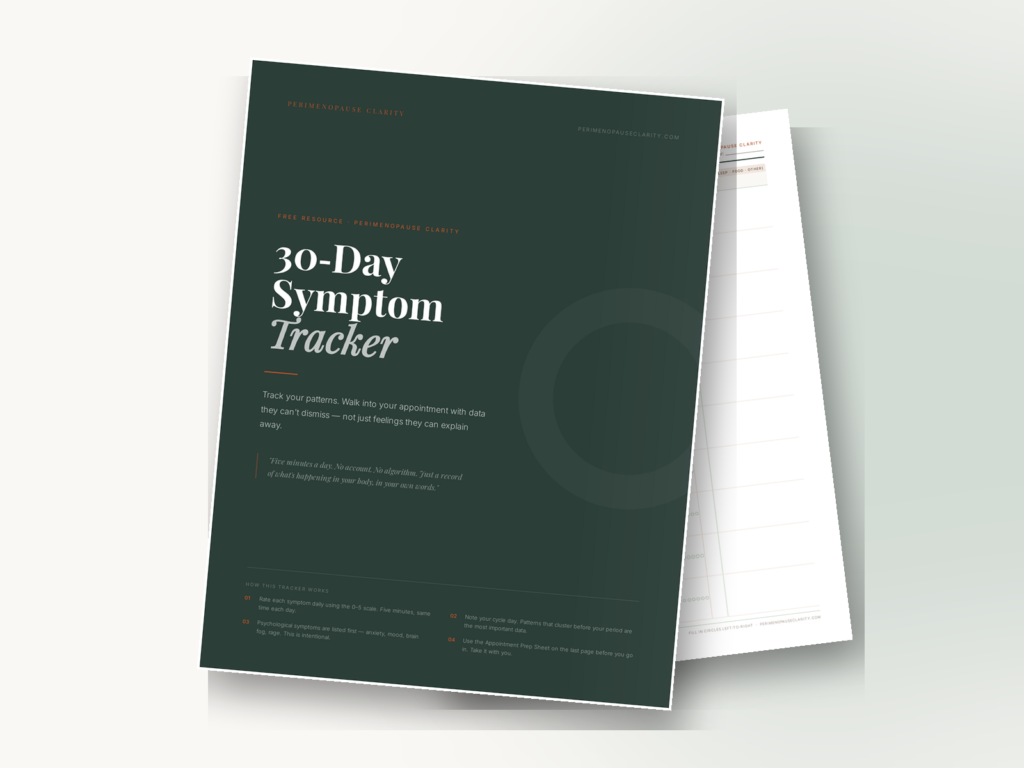
- Track the symptoms doctors keep dismissing — anxiety, rage, brain fog, sleeplessness
- Spot your cyclical pattern so you know it’s hormonal, not “just you”
- Five minutes a day. No app. No account. Just paper and proof.
- Walk into your next appointment with data, not feelings
What Is a Perimenopause Symptom Tracker — And Why Does It Matter?
A perimenopause symptom tracker is a daily log. You record how you feel, map it against your cycle, and after 30 days you have something your doctor can’t dismiss with “you seem stressed.”
That’s the whole point.
Here’s what happens without one. You go to your appointment. You describe feeling anxious, exhausted, and unlike yourself. Your doctor hears a general description of a woman who has a lot going on. You leave with nothing — or worse, with a prescription for something that doesn’t touch what’s actually happening.
Now here’s what happens with one. You go in with 30 days of data. Symptom severity scores. Cycle days. The anxiety that spikes every luteal phase like clockwork. The 3am wake-ups that cluster in the week before your period. A pattern. Patterns are clinical information. Patterns are harder to wave away.
This tracker is built around the symptoms that show up first — and get missed most. Psychological symptoms are listed before physical ones: anxiety, mood, brain fog, and rage at the top, not buried under hot flashes. Because that’s what’s actually bringing most women here. Not hot flashes. The symptoms that made you wonder if you were losing your mind.
You’re not collecting feelings. You’re collecting evidence. And evidence changes the conversation.